Posts Tagged ‘Jonathan Franklin’

A minor 2013 sidewalk dispute did not end when every charge was dismissed. It became the entry point for a police–mental-health system whose records, labels, and relationships reappeared across later arrests, neighborhood encounters, probation material, and appellate proceedings.

This investigation is based on Kevin Perelman’s firsthand account together with court records, police documents, recordings, photographs, public statements, and published reporting. Its central question is how reports of stalking, provocation, threats, and assaults were repeatedly converted into information about Perelman himself—and how psychiatric language became a shortcut for ignoring the behavior he was reporting.

The Official Version of CAMP

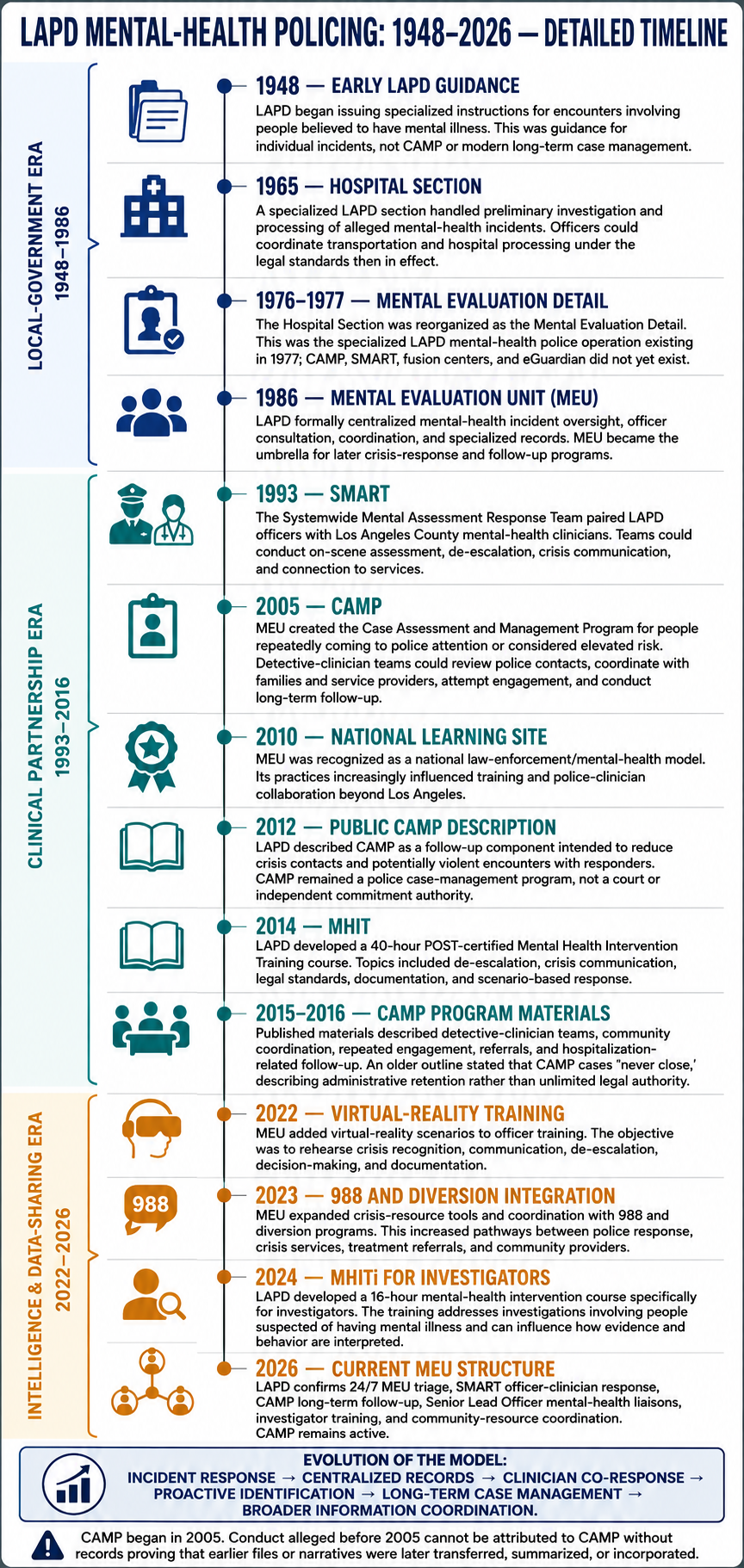
The Los Angeles Police Department’s Case Assessment Management Program—properly abbreviated CAMP, not CAM—was created in 2005 as a component of LAPD’s Mental Evaluation Unit, or MEU.

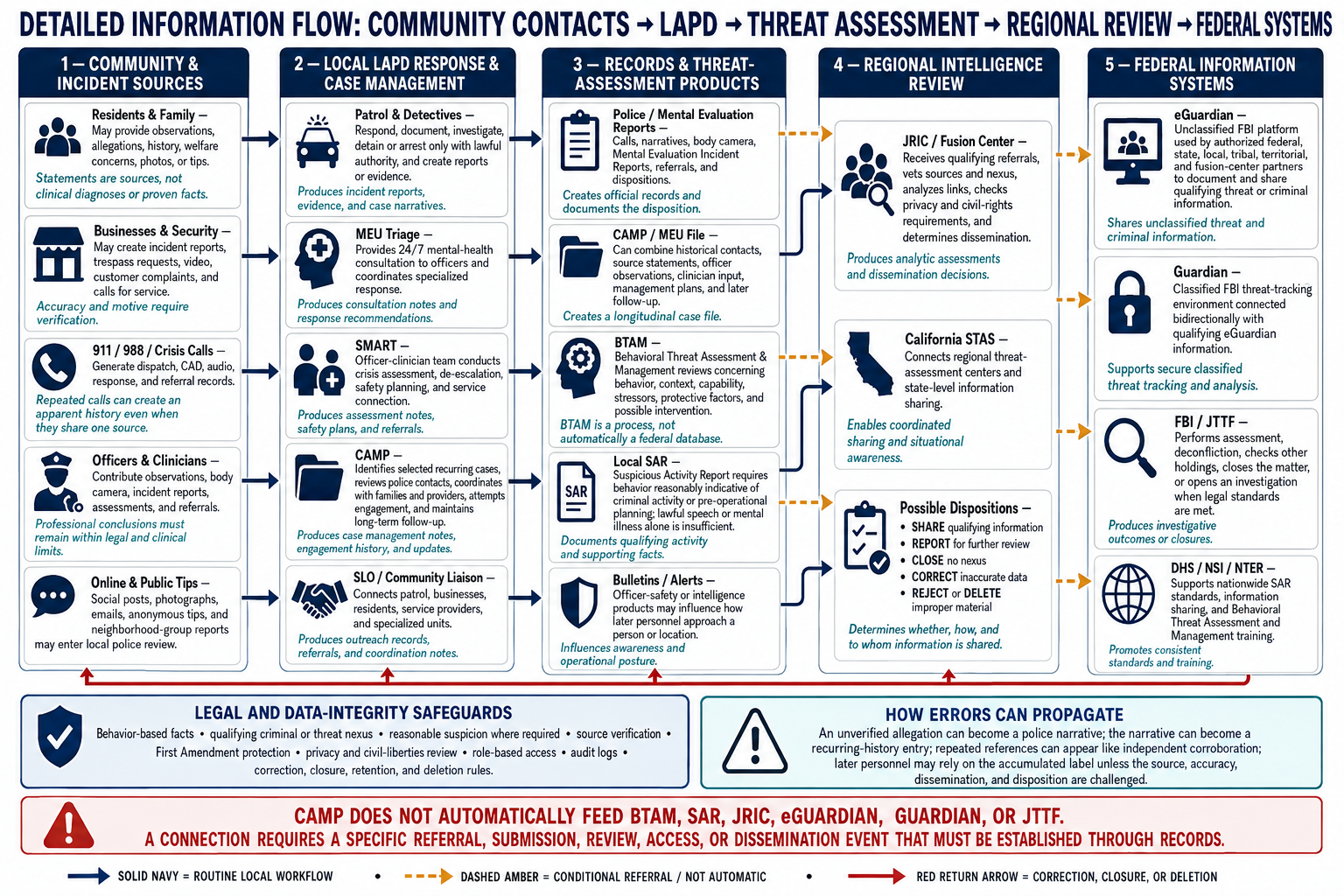
LAPD describes CAMP as a long-term follow-up program for people who repeatedly come to police attention or whom police consider potentially at elevated risk. CAMP pairs police detectives with psychologists, nurses, and social workers from the Los Angeles County Department of Mental Health. Its stated goals are to reduce repeated emergency contacts, connect people with services, and prevent violent encounters.

The federal Bureau of Justice Assistance describes CAMP more directly: it exists to identify, track, and develop individualized long-term intervention strategies for people who frequently come into contact with MEU. Bureau of Justice Assistance

An earlier LAPD outline used the words “identify, monitor, and engage.” It stated that CAMP received approximately 15 to 20 new cases each week and that its “cases never close.” At that rate, roughly 780 to 1,040 new cases could enter the system in a year. CAMP was therefore not a small, occasional crisis program; it was a continuing police–mental-health information system capable of carrying names, reports, family statements, behavioral descriptions, and psychiatric characterizations forward indefinitely.

A 2010 Department of Justice–sponsored study described how a person could enter CAMP without requesting the program or signing an agreement. Referrals could come from LAPD officers, detectives, SMART teams, school police, the Los Angeles Fire Department, or Department of Mental Health personnel. A psychologist could examine police-contact and mental-health information and decide whether the person qualified.

The same study described three levels:

  1. Active management by police and mental-health personnel.
  2. Periodic monitoring, including weekly telephone calls or monthly visits by a detective.
  3. An inactive or filed stage after the person was considered stable.

The study did not identify the subject’s signature as a prerequisite for police tracking or case creation. DOJ/BJA study

CAMP therefore is not simply a voluntary counseling program. It is a police-controlled information and case-management system operating at the intersection of law enforcement, mental-health services, family reports, community complaints, and repeated police contacts.

The Difference Between the Official Mission and Operational Reality

Government programs are ordinarily described through their lawful mission rather than every power their structure makes possible.

The National Security Agency, for example, publicly describes its work in terms of foreign intelligence and national security. That statement alone does not tell the public what data is collected, retained, searched, combined, or disseminated. Those questions require technical records, audits, access logs, court orders, and whistleblower disclosures.

CAMP raises a similar—not identical—oversight issue.

A system capable of identifying, tracking, monitoring, and engaging people over long periods can be used constructively. But it can also produce serious harm if:

  • Police accept false reports without verification.
  • Personal hostility is translated into a mental-health concern.
  • Family members supply unsupported psychiatric labels.
  • Community members repeatedly report an identified person.
  • Constitutionally protected speech is characterized as instability.
  • Dismissed allegations remain in a police database.
  • One original accusation is copied into numerous later reports.
  • Officers approach later encounters already expecting irrational or dangerous behavior.
  • Reactions to harassment are documented while the preceding harassment is omitted.
  • Lay opinions become treated as clinical findings.
  • Police and clinicians exchange information without meaningful notice to the person concerned.
  • Old characterizations are carried into later arrests, probation reports, sentencing, appeals, or CARE Act proceedings.

This can create a self-reinforcing narrative:

A community member makes an allegation. Police document it as a mental-health concern. MEU records it. CAMP sees a history of police and mental-health contacts. Later officers are warned about that history. Their observations are then interpreted through the warning. The resulting report appears to corroborate the original allegation, even though every layer originated from the same unverified source.

A police record is not a diagnosis. Repetition does not transform an allegation into medical evidence. Yet once CAMP assigns a person to continuing case management, later behavior can be interpreted through the label already attached to the file: ordinary disagreement becomes agitation, self-protection becomes paranoia, and resistance to unlawful conduct becomes supposed proof that intervention must continue. The classification can therefore manufacture the behavior it claims merely to observe.

Kevin Perelman Did Not Ask to Join CAMP

Kevin Perelman did not approach LAPD in 2013 requesting mental-health case management, psychological evaluation, or CAMP monitoring.

He was asking police to investigate and stop crimes, threats, provocations, harassment, and community activity that he was reporting against him.

According to Perelman, the plea process reversed those roles. Rather than investigating whether community members and police-connected groups were provoking and falsely reporting him, the justice system inserted CAMP into a diversion arrangement and treated Perelman as the person requiring management.

Perelman’s position is straightforward:

“I did not ask for CAMP. I asked police officers to stop crimes against me.”

The distinction is fundamental. Asking law enforcement for protection is not consent to psychiatric monitoring.

The 2013 Arrest and Five Charges

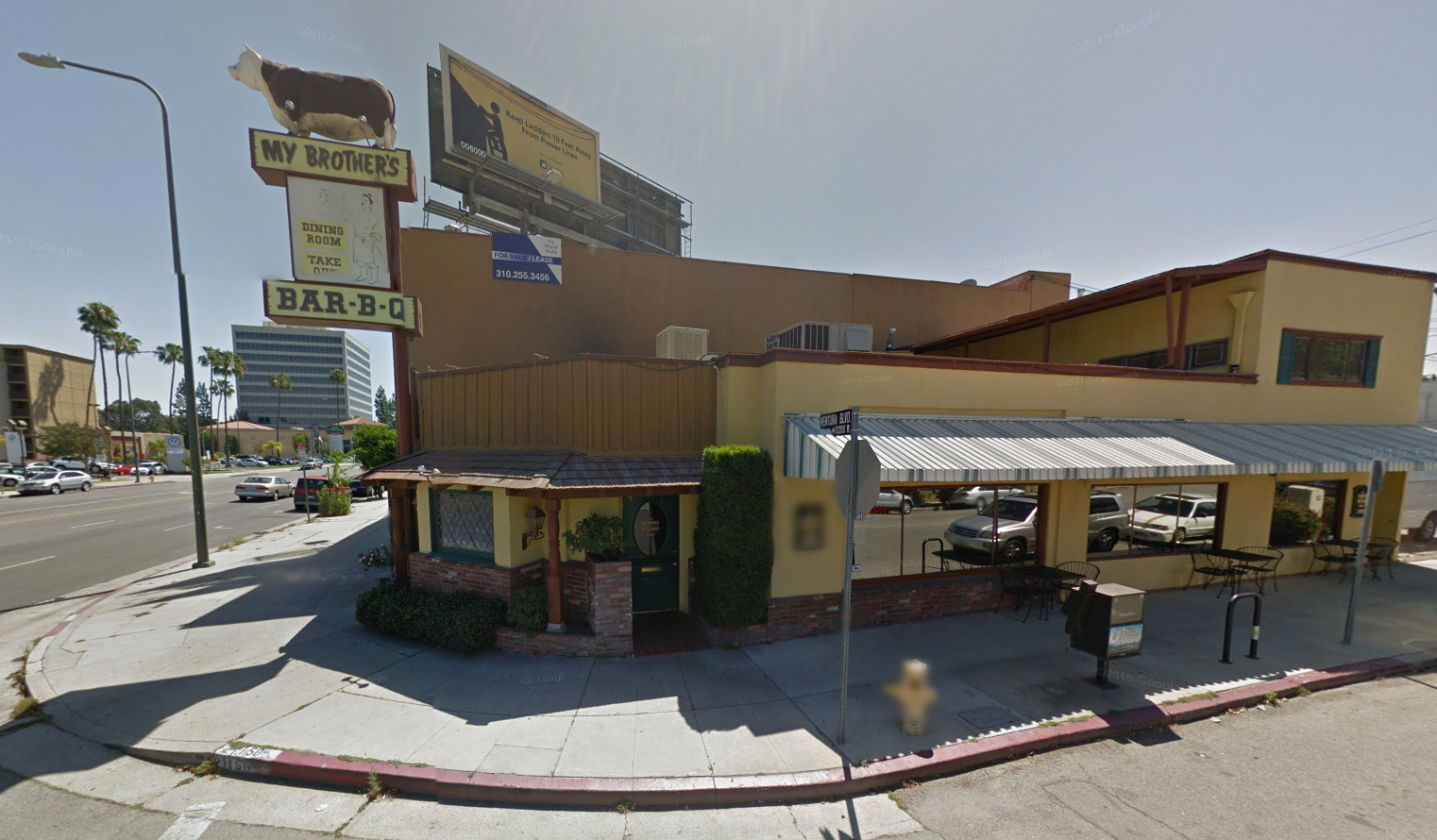
The 2013 case arose from encounters involving My Brother’s Barbecue and a nearby public sidewalk, but the sign addressed a broader pattern Kevin had experienced at restaurants and other public businesses: repeated instigation, harassment, and attempts to provoke reactions that could be portrayed as obsession, paranoia, violence, or mental illness.

Perelman states that he had previously entered the restaurant, purchased food, paid his bill, and left. He says no one told him that he was prohibited from returning and no lawful trespass warning was served.

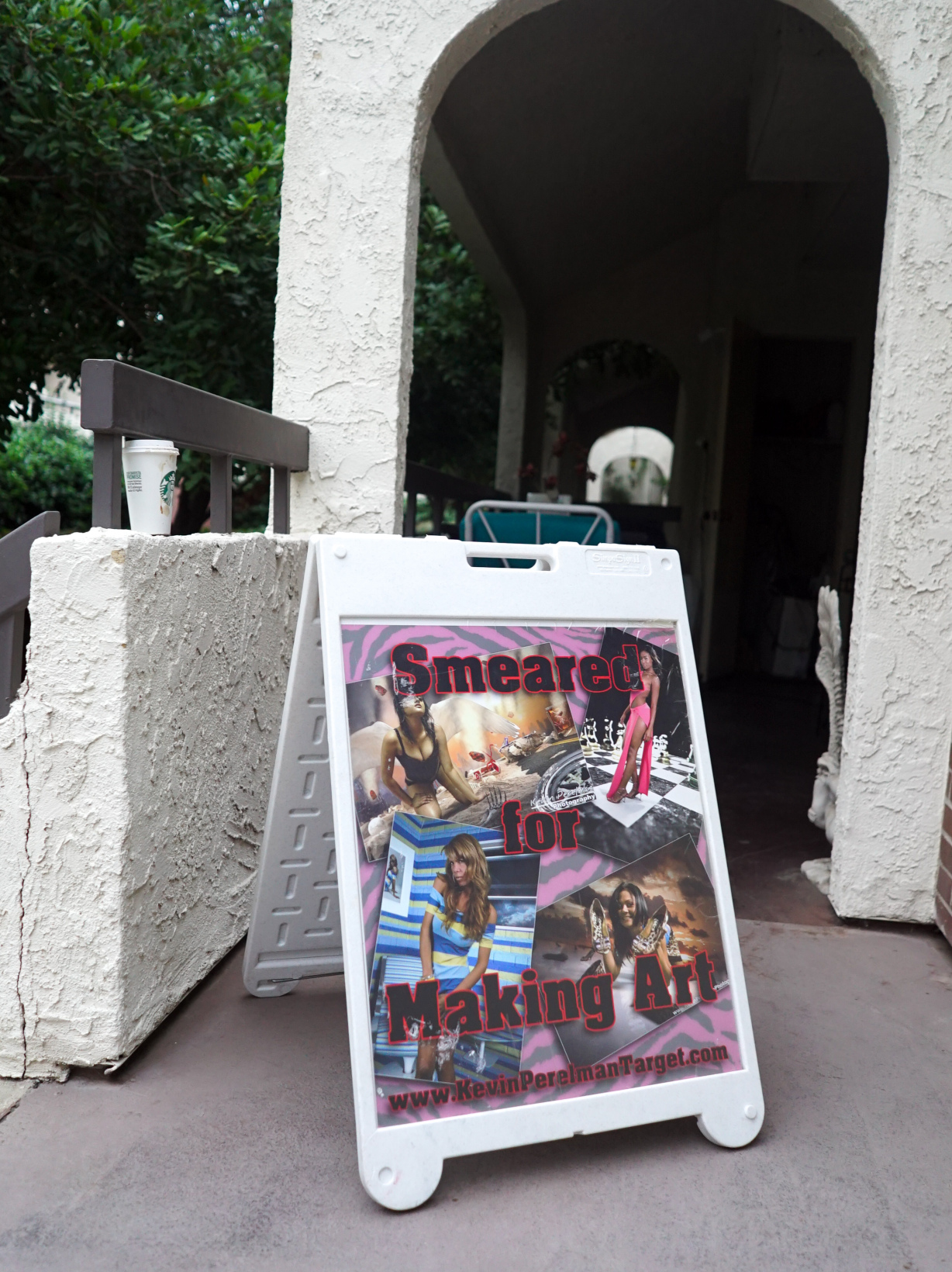
On a later date, Perelman sat outside on a public sidewalk with a small sign reading:

“Smeared for Creating Art.”

There was no homeless encampment. The sidewalk was quiet and lightly traveled—not a crowded commercial walkway—and the small sign did not block pedestrian traffic or occupy the restaurant’s private property. A minor sidewalk encounter was nevertheless dramatized into multiple allegations and then expanded into a five-count case, functioning like a Trojan horse into CAMP and MEU involvement.

The newly obtained courthouse minute orders now establish precisely how the case expanded.

At the July 5, 2013 arraignment, the filed complaint contained two misdemeanor counts:

  • Count 1: Los Angeles Municipal Code §41.18(d).
  • Count 2: Los Angeles Municipal Code §41.18(a).

The minute order identifies Citation No. 02085 but does not reproduce the physical citation or establish which offense Jensen wrote on it. It also lists Deputy Public Defender Anna Brief at the July 5 arraignment. Kevin never retained or knowingly worked with a public defender; he hired Jonathan Franklin immediately. The unexplained Anna Brief entry is therefore a discrepancy in the court record, not part of Kevin’s actual attorney relationship.

On August 19, 2013, Perelman was not present. Jonathan Franklin appeared for him under Penal Code §977. On the prosecution’s motion, Judge Shellie Samuels ordered the complaint amended “by interlineation” to add three more misdemeanor counts:

  • Count 3: Penal Code §602(k).
  • Count 4: Penal Code §242.
  • Count 5: Penal Code §602(k).

Franklin entered not-guilty pleas to those three added counts on Perelman’s behalf. The record therefore confirms that counts 3 through 5 were added later, at the prosecution’s request, while Perelman was absent.

Perelman states that the two trespasses never occurred because he was outside on a public sidewalk and had never been told during his earlier paid visits that he was barred from the restaurant.

He likewise disputes the allegation that he threw a business card at anyone. Even as described by police, the allegation involved a lightweight card rather than an instrument reasonably capable of producing the grave harm later implied by the accumulation of charges.

Perelman says Officer Jensen approached him about leaving the sidewalk. Perelman was prepared to leave but first asked for Jensen’s badge number because the officer appeared unconcerned about the provocations and harassment Perelman was reporting. Jensen responded by issuing the misdemeanor citation. The newly produced records show that the final three allegations were not all placed on that citation at the scene; they were added to the court complaint later on the prosecution’s motion.

LAPD Officer Charles “Sean” Dinse was involved in the 2013 police activity. Perelman identifies this as Dinse’s first visible appearance in a series of later cases and community-policing events involving him.

On September 26, 2013, Perelman entered a no-contest plea to count 1, §41.18(d). The court entered an interim finding of guilt. Counts 2, 3, and 4 were dismissed under Penal Code §1385, while count 5 remained pending.

The court’s case history expressly states:

“THIS IS A CONDITIONAL PLEA (SEE WRITTEN AGREEMENT IN FILE).”

The matter was continued for a March 26, 2014 progress report and a September 26, 2014 probation-and-sentencing hearing.

On September 26, 2014, the court granted Perelman’s motion to withdraw the plea and ordered the plea vacated. Counts 1 and 5 were dismissed under Penal Code §1385. The prosecution moved to dismiss the case “pursuant to the original plea agreement,” the motion was granted, and the proceedings were terminated.

The final legal result was therefore not a surviving conviction. The no-contest plea and interim finding on count 1 were withdrawn and vacated, every count was dismissed, and the entire case was terminated. On December 5, 2014, an arrest-disposition report was transmitted electronically to the California Department of Justice.

Officer Jeffrey Christopher Jensen: Identity, Public Record, and the 2013 Citation

Jeffrey Christopher Jensen is identified in public LAPD-roster, California POST, payroll, and officer-profile compilations as LAPD Serial No. 37340. The public profile reviewed for this reconstruction lists badge No. 19909 as of September 2024, the rank of Police Officer II, a December 13, 2004 hiring date, POST ID B75-W87, and a Topanga Division assignment as recently as April 2025. Assignments and badge numbers can change; the serial number is the more reliable identifier for records requests.

What Public Records Show—and What They Do Not

A broad public search did not uncover an accessible sustained disciplinary finding or individualized Brady disclosure for Jensen. That absence is not a clean bill of health: police complaints, nonsustained allegations, confidential personnel files, settlements, and unindexed matters frequently do not appear in ordinary searches.

A commercial Giglio-Brady profile reports no previously disclosed Brady material for Jensen. The point is not that the website proves misconduct; it shows readers where officer-credibility disclosures may be catalogued and why the underlying agencies—not a commercial index—must answer whether impeachment material exists.

Jensen’s Disputed Role in the 2013 Incident

Perelman identifies Jensen as the officer who approached him during the restaurant and public-sidewalk episode underlying Case No. 3PY03498. Perelman states that he was on a public sidewalk displaying the sign “Smeared for Creating Art,” was prepared to leave, and requested Jensen’s badge or identifying information because Jensen appeared unconcerned about the provocations and harassment Perelman was reporting. According to Perelman, the identification dispute was followed by Jensen issuing misdemeanor Citation No. 02085.

The recovered court record establishes that the filed case began with two municipal-code counts and later expanded, on the prosecution’s motion while Perelman was absent, to include two Penal Code §602(k) trespass counts and one Penal Code §242 battery count. The minute orders do not reproduce the physical citation or establish which offenses Jensen placed on it. The no-contest plea and interim finding were later withdrawn and vacated; all five counts were dismissed under Penal Code §1385 and the proceedings were terminated on September 26, 2014.

The sequence makes Jensen’s conduct central to the story. A dispute on a quiet sidewalk began with a citation and later grew into five counts. The public record does not show that Jensen personally created every added allegation, but it places his police contact at the front of the chain that ultimately led to Franklin’s plea arrangement and CAMP.

Jonathan Franklin and the Unexplained CAMP Provision

Kevin hired private attorney Jonathan Franklin immediately after the case began.

Franklin made a categorical statement that defined the defense he would not provide:

“I won’t say anything bad about a police officer.”

That statement goes to the center of Franklin’s representation. Perelman hired a defense lawyer because police conduct, witness coordination, and community provocation were the defense—not side issues. A lawyer who refuses at the outset to criticize an officer has already removed the client’s central explanation from the case.

Franklin failed to investigate the behavior at the center of the defense:

  • Whether Perelman had actually been told to leave the restaurant.
  • Whether Perelman was on private property when police arrived.
  • Whether the sidewalk was obstructed.
  • Whether the business-card allegation occurred.
  • Whether restaurant employees supplied false or coordinated statements.
  • Whether officers padded a minor sidewalk encounter with unsupported charges.
  • Whether community provocations preceded the police contact.
  • Whether Dinse and Jensen had prior information or motives affecting their response.

Whether community members intentionally placed Kevin in confrontations he tried to avoid, creating self-defense and witness-impeachment issues.

Whether a private investigator could have documented provocation, motive, malice, police involvement, and the coordinated creation of a misleading paper trail.

During one restaurant encounter, an employee reportedly initiated an unsolicited and cryptic discussion stating that people should not post businesses on Yelp. Perelman had not mentioned Yelp. He understood the statement as either an attempt to provoke a reaction or an indirect warning not to report the restaurant’s treatment of him.

Rather than investigate that context, the plea process introduced CAMP. Franklin represented that the arrangement would work with Kevin to stop the community-harassment groups, then supplied a CAMP contact number connected to psychological evaluation. The promised investigation of the reported actors became assessment of the reporting person. Franklin accepted private payment while refusing to challenge the police conduct that formed the core of his client’s defense.

The newly recovered paperwork makes the nondisclosure issue more concrete. Perelman signed page 3 of the standard PRU-200 misdemeanor plea form. That page records the no-contest plea to count 1 and contains Franklin’s attorney certification. A complete blank PRU-200, Revision 1-2013, confirms that CAMP is not part of the standard four-page form.

The surviving signed PRU-200 does not:

  • Mention CAMP.
  • Describe CAMP’s police–mental-health purpose.
  • Authorize a mental-health evaluation.
  • Provide consent for mental-health case management.
  • Explain information collection, retention, or disclosure.
  • Identify CAMP participation as a condition of the plea.
  • State that CAMP officers would substitute for ordinary criminal investigators.

The court’s own records nevertheless describe the disposition as a conditional plea governed by a separate “written agreement in file.” The transcript separately discusses CAMP and records Judge Samuels incorporating an unidentified “second sheet” into the sentencing sheet.

Neither the separate written agreement nor the second sheet appears in the courthouse production. The existing evidence therefore does not establish that Perelman placed his signature on a document expressly agreeing to CAMP. It establishes that he signed a general PRU-200 plea form while a separate conditional agreement existed outside that signed form.

No separate CAMP agreement was disclosed or explained to Kevin and no copy was provided. A later comparison with a complete blank PRU-200 confirmed that the ordinary missing form page contained routine checkboxes and was not the substantive mystery. The unresolved documents are the separate “written agreement in file” and the transcript’s unidentified “second sheet.” If Kevin signed or accepted any additional term, it followed a discussion he says misrepresented CAMP as help against harassment rather than police–mental-health management of him.

The missing transcript and agreement leave the public without answers to basic questions:

  • Who first requested CAMP.
  • What Franklin told Perelman privately.
  • What the prosecutor represented.
  • What Judge Shelly Samuels said.
  • Whether CAMP was described as voluntary.
  • Whether information sharing was explained.
  • Whether the arrangement required an evaluation.
  • What the signed PRU-200 authorized and what, if anything, was separately authorized by the missing written agreement.
  • Whether police assistance was offered as an inducement.
  • Whether Perelman’s agreement was knowing and informed.

Franklin’s signed attorney statement is material because it states that counsel reviewed the plea form and any addenda, explained the consequences, discussed the facts and possible defenses, answered the defendant’s questions, and concurred in the plea and waiver. That certification must be reconciled with the missing written agreement, the unidentified second sheet, the absence of CAMP language from the signed PRU-200, and Perelman’s statement that CAMP was not disclosed to him as the substitute for the investigative assistance he requested.

Judge Shelly Samuels and the Missing Context

The March 26, 2014 hearing was a six-month progress review within a twelve-month conditional disposition: the plea was entered September 26, 2013, the progress hearing occurred March 26, 2014, and the plea was withdrawn and every remaining count dismissed September 26, 2014. At the midpoint hearing, Judge Samuels discussed whether Kevin was “doing well,” asked, “Can you do it for 12 months?” and then, “Can you then do it for the rest of your life?” When Kevin asked, “Do I have the civil rights to make that decision?” Samuels answered, “No, you don’t have civil rights to break the law.”

A letter from therapist Karine Echigian was dated March 25, 2014—one day before that progress hearing—and documented sessions that had begun May 13, 2013, before the criminal case was filed. The timing strongly indicates that the letter was prepared or obtained for the court’s progress review. The surviving record does not show whether therapy was a formal condition, an informal expectation, or material Franklin voluntarily presented to show Kevin was “doing well.” Because the separate conditional agreement and unidentified second sheet have not been produced, the record cannot rule out a separately documented therapy requirement.

The transcript still does not identify with precision what “it” meant. The formal March 26 minute order states only that the matter remained on calendar as previously set. It does not identify a treatment condition, CAMP requirement, prohibited conduct, or specific law under discussion.

The exchange is troubling because Perelman’s reference to civil rights was immediately reframed as though he were claiming a right to commit crimes. The later September 26, 2014 order is also critical: the plea was withdrawn and vacated, the remaining counts were dismissed, and the entire case was terminated.

The significance of the exchange is not limited to proving the private meaning of one remark. The court used indefinite language without identifying what Perelman was expected to do for life, what law he was supposedly threatening to violate, or whether “it” included continued CAMP contact or police–mental-health management. When Perelman raised civil rights, the court substituted accusation for clarification.

Within the broader chronology presented here, the exchange supports the inference that the proceeding was being used to obtain submission to an institutional narrative rather than to examine the reported police and community misconduct. Perelman’s interpretation is that the lifelong expectation was continued monitoring, provocation, selective documentation, and psychiatric labeling until authorities obtained the result they wanted. The missing written agreement, unidentified second sheet, CAMP records, and complete transcript are therefore central evidence, not peripheral paperwork.

The unresolved questions include whether:

  • “It” referred to completing the twelve-month conditional arrangement.
  • The question concerned ordinary compliance with law.
  • The question concerned CAMP contact, case management, treatment, or another undisclosed term.
  • Perelman was attempting to preserve his right to object to police misconduct and constitutional violations.
  • The judge understood CAMP’s actual function.
  • The missing written agreement would identify the condition being discussed.

Perelman has now obtained additional minute orders from the courthouse. Those records confirm the conditional plea and complete dismissal, but they do not include the separate “written agreement in file” or the transcript’s unidentified second sheet. The production includes page 1 and a largely blank page labeled page 3 of the September 26, 2013 formal minute order, without an identifiable page 2. The absence of these documents prevents full examination of what was agreed concerning CAMP, mental health, police assistance, and the later civil-rights exchange.

The Assistance Perelman Requested Never Materialized

Perelman says he agreed to diversion because he believed LAPD would provide a legitimate contact who could help address the community harassment and repeated provocations he was reporting.

Instead, he received telephone numbers and what he describes as approximately one meaningful telephone contact. Police did not investigate the larger network he was reporting, did not stop the community activity, and did not provide a detective willing to examine evidence against the reporting parties.

The new courthouse records confirm that the plea was expressly conditional, but the document defining those conditions is missing. This makes the promised assistance more than a collateral misunderstanding: police assistance may have been part of the consideration inducing the plea, while the actual mechanism supplied was CAMP rather than criminal investigation.

The distinction is operationally fundamental. A criminal investigator receives reports, interviews witnesses, preserves evidence, identifies suspects, evaluates probable cause, and investigates whether an offense occurred. CAMP identifies, assesses, monitors, engages, refers, and manages the person selected for police–mental-health attention. Calling both arrangements “police assistance” conceals the difference between investigating crimes reported by Perelman and assessing Perelman himself.

The substitution worked like this:

Perelman requests investigation of crimes against him
                         ↓
Police and counsel redirect the matter into CAMP
                         ↓
Community allegations become information about Perelman
                         ↓
Police do not investigate whether those allegations were fabricated
                         ↓
Mental-health management replaces criminal investigation

The unanswered question is no longer whether the visible PRU-200 signature mentions CAMP; it does not. The unanswered questions are what the missing conditional agreement contained, whether it mentioned CAMP, whether Perelman saw or signed it, and whether it purported to authorize broader police–mental-health information exchange.

The Public Directive to “Deem” Kevin Perelman Mentally Ill

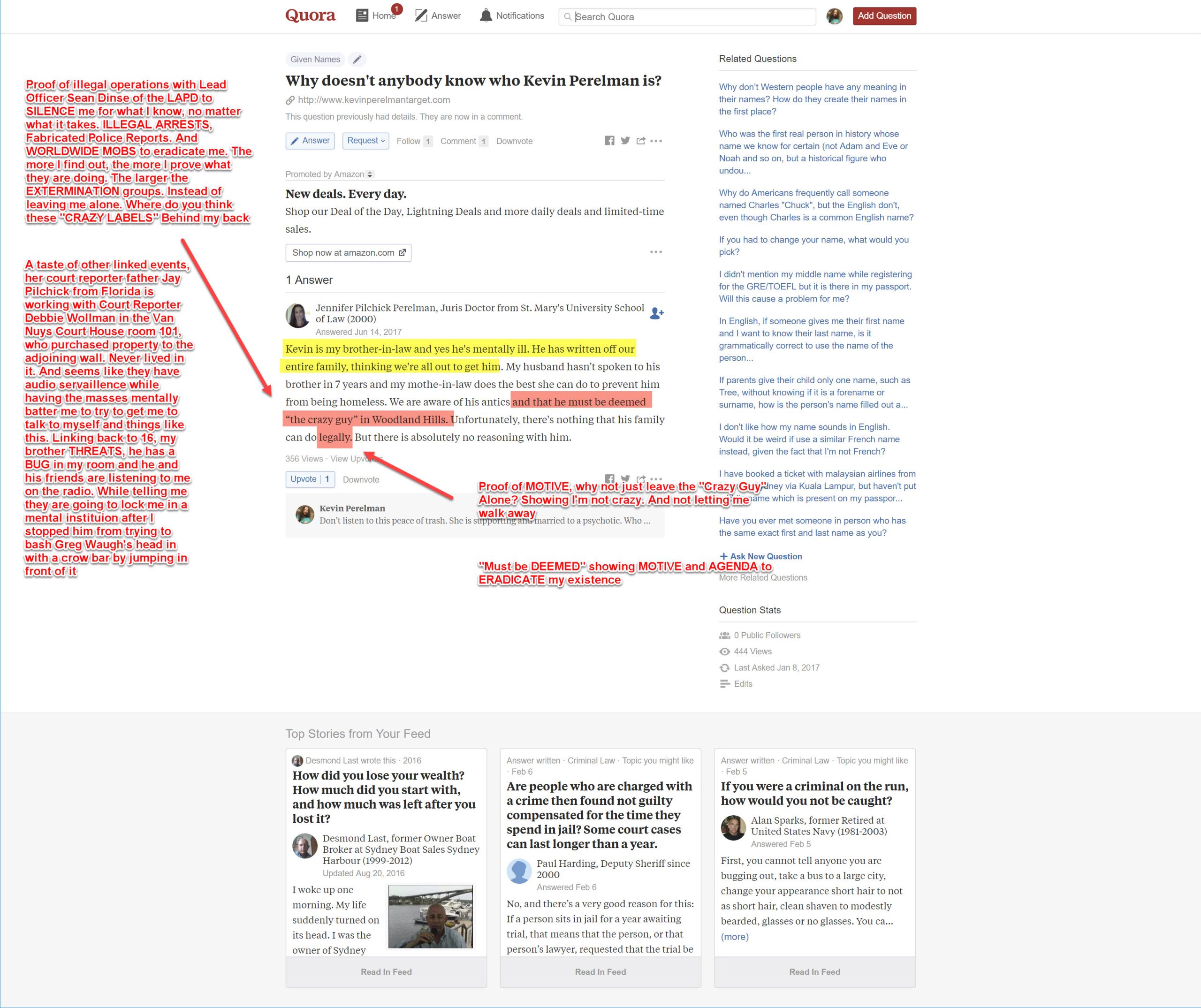
A preserved, annotated screenshot shows a June 14, 2017 Quora response attributed to Jennifer Pilchick Perelman. She is Kevin Perelman’s sister-in-law and the wife of his brother, not an unrelated online commenter. The page identifies her as holding a Juris Doctor from St. Mary’s University School of Law. Federal Election Commission records identify Jennifer Pilchick Perelman as a Democratic candidate for the United States House of Representatives in Florida District 23 during the 2020 election cycle and Florida District 25 during the 2024 cycle.

“Kevin is my brother-in-law and yes he’s mentally ill. He has written off our entire family, thinking we’re all out to get him. My husband hasn’t spoken to his brother in 7 years and my mother-in-law does the best she can to prevent him from being homeless. We are aware of his antics and that he must be deemed ‘the crazy guy’ in Woodland Hills. Unfortunately, there’s nothing that his family can do legally. But there is absolutely no reasoning with him.”

The key words are “must be deemed.” This was not phrased as private concern or a request for treatment. It was a public directive to establish an identity: Kevin must become “the crazy guy” in Woodland Hills. Once that identity is accepted, reports of stalking become “paranoia,” objections become “instability,” and reactions to provocation become supposed proof of the label. The behavior causing the damage disappears; only Kevin’s response remains visible.

Political, Legal, and Network Resources

Jennifer Pilchick Perelman was Kevin’s sister-in-law, an attorney, and later a two-time congressional candidate. Those positions gave her statement more apparent authority and access to legal, political, media, professional, and community networks than an anonymous commenter. Her residence in Florida sharpens the public-interest question: why was a relative across the continent working to establish Kevin’s psychiatric identity in a California neighborhood when she and Kevin had never had a substantive dialogue about the behavior being directed at him? “There is absolutely no reasoning with him” described a conversation that never occurred.

The stated purpose was “help,” but the asserted remedy was loss of credibility, control, property, freedom, or institutionalization. That contradiction creates the motive question at the center of the family narrative: why devote distant legal and social resources to removing someone from ordinary life rather than speak directly with him or investigate what he was reporting?

The Credibility-Neutralization Conspiracy

The evidence is presented as a continuing conspiracy rather than a collection of isolated psychiatric remarks. Its method is to monitor Perelman, provoke or engineer encounters, omit the precipitating conduct, preserve only his reactions, circulate psychiatric labels, and then use those labels to discredit his reports of the conduct directed against him. The label becomes both the weapon and the cover-up. Reports of misconduct are reframed as paranoia; constitutional objections become instability; and reactions to provocation are offered as supposed confirmation of the original label.

Kevin traces the false labeling to early childhood, decades before CAMP existed. In his account, the system did not discover a psychiatric problem; it inherited a family narrative, amplified it through friends and community contacts, and eventually placed it inside police, mental-health, prosecution, probation, and court channels. The people claiming to “help” were simultaneously creating the damage used to justify more intervention.

Claimed Family, Court-Reporting, Property, and Police Hierarchy

The reported hierarchy begins with family monitoring and communications, extends through Jason and Jennifer Pilchick Perelman’s labeling, her father’s connection to the court-reporting business, and court reporter Debbie Wollman’s purchase of property adjoining a wall of Kevin’s residence despite not occupying it. Wollman was a Van Nuys courthouse employee during the period surrounding the 2017 arrests and proceedings. Video records Wollman pressing psychiatric labels and attempting to discourage Kevin from going to the courthouse—a striking intervention when attendance was necessary to defend the criminal cases. These relationships supplied pathways through which family allegations, observations, recordings, and psychiatric labels could move into neighborhood, police, court-reporting, and court networks.

This hierarchy becomes directly relevant to Dinse because his publicly documented neighborhood-policing model connected residents, businesses, homeowners’ associations, Facebook and Nextdoor groups, neighborhood watch participants, and LAPD resources. The question is whether the family-generated label or substantially identical language entered those networks and was then used to solicit monitoring, calls for service, business exclusions, confrontations, welfare checks, arrests, CAMP or MEU referrals, probation narratives, or later court action.

The supplied screenshot directly establishes the public statement and Perelman’s contemporaneous annotations. The remaining links should be established through records rather than assumed from proximity alone. That requires examination of:

  • Communications among Perelman’s brother, Jennifer Pilchick Perelman, her father, Debbie Wollman, Dinse, Jensen, LAPD, CAMP or MEU personnel, prosecutors, defense lawyers, court personnel, and neighborhood groups.
  • Certified property, assessor, escrow, lease, utility, and occupancy records for the property adjoining Perelman’s residence.
  • Court-reporter licensing, employment, assignment, invoice, calendar, transcript-access, and conflict-disclosure records.
  • Evidence showing whether audio, video, telephone, internet, location, or other information was collected from or transmitted concerning Perelman’s residence.
  • The first appearance of the phrases “mentally ill,” “crazy guy,” “schizophrenia,” “paranoia,” “no reasoning with him,” or equivalent language in family, neighborhood, police, CAMP, MEU, prosecutorial, probation, appellate, or court records.
  • Whether any recipient treated Jennifer Pilchick Perelman’s status as a lawyer, family member, or congressional candidate as validation of an otherwise unsupported psychiatric assertion.

Annotated screenshot supplied by Kevin Perelman. The quoted Quora response is the underlying source material; the red annotations state Perelman’s interpretation and identify additional relationships requiring documentary verification.

Charles “Sean” Dinse and Internet-Connected Neighborhood Policing

Dinse is not merely an officer whose name appears in Perelman’s cases.

He is an LAPD Senior Lead Officer assigned to Topanga Division. LAPD currently lists him as the Senior Lead Officer for Basic Car 21A43. LAPD Topanga Division

In a 2014 official LAPD Nextdoor post, Dinse described himself as responsible for monitoring crime trends, “quality of life,” and Neighborhood Watch. He stated that numerous local watch groups used Facebook and other communication systems. He wanted Nextdoor to become his primary communication network while he continued communicating through Facebook. Dinse’s Nextdoor statement

That establishes a deliberate internet-connected police-community structure:

Residents, businesses and HOAs
                ↕
Neighborhood-watch groups
                ↕
Facebook and Nextdoor
                ↕
Senior Lead Officer Dinse
                ↕
Topanga Division and LAPD resources

The structure does not make every participant a police agent. It does show that Dinse intentionally connected community groups, gathered information from them, and distributed police-related information through online networks.

Crimebusters and Anti-Homeless Facebook Groups

Dinse reportedly participated in two private Facebook groups:

  • “Crimebusters of West Hills and Woodland Hills”
  • “Homeless Transient Encampments of Our West Valley”

Los Angeles Magazine reported that Dinse regularly used the groups to gather information about encampments and track specific unhoused individuals. Los Angeles Magazine

Knock LA reported that the groups included current and former officers, LAPD volunteers, neighborhood-watch participants, and community members. Members reportedly posted photographs, locations, personal property, allegations, and strategies for removing unhoused people. Some comments advocated violence or destruction of property. Knock LA

L.A. Taco reported that Dinse rejoined one group after LAPD leadership reportedly instructed officers not to participate. L.A. Taco

These reports are relevant because they independently document the type of digitally coordinated police-community activity Perelman says affected him.

Rex Schellenberg’s Federal Civil-Rights Lawsuit

Rex Schellenberg, an elderly unhoused man who slept in or near his vehicle, filed a federal civil-rights case against Dinse and the City of Los Angeles:

Rex Schellenberg v. City of Los Angeles, Sean Dinse, et al. Central District of California Case No. 2:20-cv-01313 Filed February 10, 2020 Cause of action: 42 U.S.C. §1983

The federal docket confirms Dinse was personally named as a defendant. Federal docket

According to the complaint as reported by the Los Angeles Times, Dinse allegedly:

  • Shared information about where Schellenberg was staying.
  • Encouraged residents to contact police.
  • Used resulting calls as a pretext for police intervention.
  • Shared sensitive and erroneous personal information.
  • Suggested Schellenberg had lost housing because of “drug addiction/mental illness.”
  • Targeted Schellenberg’s van for repeated towing.
  • Used online groups to monitor Schellenberg’s location and activity.

Schellenberg denied suffering from drug addiction or mental illness beyond the understandable stress and trauma of homelessness. Los Angeles Times

The accessible docket does not establish a final judicial finding against Dinse. The allegations nevertheless provide an independently documented parallel:

  • An identified person in public space.
  • Community members photographing and reporting him.
  • A police officer gathering and circulating information.
  • Unsupported mental-illness labeling.
  • Repeated enforcement contacts.
  • Efforts to remove the person or his property.
  • A resulting federal §1983 lawsuit.

Sleeping in a vehicle or being disliked by a neighborhood is not, by itself, proof of criminal conduct or mental illness.

The Bailey Bernard Incident: When the Caller Became the Accused

The Bailey Bernard incident shows the alleged operation in human terms. Perelman says Bernard followed him approximately 600 feet toward his home, screamed at him, demanded, “Is this where you live?” and struck the keys from his hand as Perelman entered the gate to his residential complex. A fight followed. Perelman called 911 and then drove to the police station seeking help.

The case nevertheless cast Perelman as the aggressor. The central evidence should have been straightforward: who followed whom, who initiated contact at the gate, who knocked away the keys, what the 911 recording showed, and what officers were told at the station. Instead, Perelman says the preexisting mental-health narrative allowed police and prosecutors to accept Bernard’s cover story and discount the report of the person who called for help.

Mental illness—real or invented—does not erase a person’s right to report a crime. Yet that is the practical effect Perelman describes: label the reporting person paranoid, treat the opposing account as inherently credible, and use the resulting prosecution as new “proof” that the label was correct.

Perelman’s Three Arrests and Three Criminal Proceedings

Perelman identifies Dinse as connected to three arrests and three criminal proceedings beginning in 2013 and continuing through the 2017 and 2023 matters.

He characterizes the proceedings as constitutionally defective because the courts repeatedly addressed his reactions while excluding or suppressing evidence concerning the preceding assaults, threats, provocations, community activity, police relationships, and allegedly false reports.

Among the events Perelman says were ignored or buried were:

  • A woman attempting to attack him with a knife.
  • A neighbor’s dog, described as police-trained, severely injuring his leg.
  • Reports involving Detectives Angela Stewart and Shapiro that allegedly failed to document or investigate the attacks adequately.
  • Repeated community assaults and batteries.
  • Police reports that allegedly reversed victim and suspect roles.
  • Community members provoking confrontations and then calling police.
  • Statements and conduct by HOA members connected with neighborhood-policing networks.
  • Dinse appearing at or influencing repeated enforcement encounters.
  • Prosecutorial narratives omitting the precipitating conduct.

Perelman also alleges prosecutorial misconduct by prosecutors he identifies as Green T. Phillips and Ingo Orbeli. Among the disputed statements, Perelman says Orbeli claimed that he followed Dinse to Dinse’s home on a court date. Perelman disputes that allegation and considers it part of an effort to portray him as obsessed with or threatening toward the officer.

These allegations require comparison against transcripts, police reports, GPS or location records, body-camera footage, witness statements, and the prosecutors’ evidentiary proffers.

Judge Gregory Dohi and the Denied Pitchess Motion

During the 2023 prosecution, the defense sought personnel information concerning Dinse through a Pitchess motion.

Judge Gregory Dohi denied disclosure concerning Dinse while allowing disclosure concerning Officer Ruiz.

That decision is significant because Dinse had already:

  • Been personally named in the Schellenberg federal civil-rights lawsuit.
  • Been publicly associated with online groups tracking specific people.
  • Been accused of distributing unsupported mental-illness and addiction narratives.
  • Participated in internet-connected neighborhood-watch systems.
  • Appeared in Perelman’s earlier police encounters.

A denial of a Pitchess request is not proof that no relevant complaints existed. It may mean the court considered the defense showing insufficient, conducted an in-camera review and found nothing discoverable, limited the categories searched, or applied a restrictive relevance determination.

The sealed transcript and in-camera record are necessary to determine:

  • What records the custodian brought.
  • Which years and complaint categories were searched.
  • Whether the Schellenberg litigation was disclosed.
  • Whether complaints involving social-media monitoring were considered.
  • Whether false reporting, retaliation, unlawful detention, dishonesty, or improper information dissemination were included.
  • Whether the court relied on an incomplete custodian declaration.

Engineered Social Contacts and Contaminated Collateral Information

Perelman further identifies people who allegedly entered his social environment, cultivated familiarity, followed or appeared around him in social groups, attempted to elicit statements, and then supplied police-connected participants with psychiatric interpretations of those statements. He maintains that this conduct was designed to create reactions or fragments of conversation that could be removed from context and used to portray him as irrational.

One person Perelman identifies is Dr. Steve Levinson, whom he describes as an elderly, no-longer-practicing gastroenterologist formerly associated with Tarzana Medical Center, where Perelman’s father also worked. Perelman reports that Levinson—approximately his father’s generation—befriended him, appeared with groups in social settings, attempted to draw out statements that could later be characterized as evidence of mental illness, and had professional or social connections capable of carrying those characterizations back to family members, police, or mental-health personnel. Levinson’s exact age, employment history, relationships, communications, and role remain subjects for documentary verification.

This alleged pathway matters because a later evaluator may receive third-party statements, welfare-check narratives, police contacts, or community complaints as supposedly neutral ‘collateral history’ without being told how the encounters were initiated. If a reporting person arranged or facilitated the contact, arrived with police, provoked the disputed conversation, selectively described what occurred, or supplied the psychiatric interpretation afterward, the resulting record would not constitute independent clinical corroboration.

Perelman describes a police visit in which a person involved in initiating or facilitating the contact allegedly appeared with officers, while the resulting narrative nevertheless characterized Perelman as suffering from mental illness. The precise date and report number must be confirmed before the incident is assigned a fixed chronology. The complete source record should identify the caller, accompanying civilians, dispatched officers, pre-arrival communications, statements made at the scene, body-camera footage, CAD comments, reports, database entries, and every later dissemination.

The resulting information pathway can be stated directly:

Engineered or selectively reported social encounter
                         ↓
Police visit, welfare check, complaint, or community report
                         ↓
Lay psychiatric interpretation entered as collateral information
                         ↓
CAMP, MEU, probation, prosecution, or evaluator receives the record
                         ↓
Repetition is presented as independent corroboration
                         ↓
Perelman’s contrary evidence is discounted because of the label

An evaluation based on contaminated or circular source material would reproduce the originating narrative rather than independently establish a diagnosis. The relevant inquiry is therefore not merely whether an evaluator repeated a label, but who supplied each source, what relationship that person had to Perelman’s family or police-connected networks, whether the source participated in producing the encounter, what exculpatory context was omitted, and whether the evaluator was told of those conflicts.

Records necessary to examine this pathway include:

  • The original CAD event, 911 or non-emergency call, dispatch audio, body-camera video, station video, and incident reports for each disputed police visit.
  • The identities and relationships of callers, accompanying civilians, social-group participants, officers, supervisors, CAMP or MEU personnel, and evaluators.
  • Communications involving Levinson, Perelman’s father or other family members, Dinse, Linton, Espinoza, neighborhood groups, police personnel, or mental-health personnel.
  • Every referral, field-interview entry, mental-evaluation report, database notation, risk flag, officer-safety notation, collateral-source summary, and dissemination log derived from the encounters.
  • The unedited recordings and surrounding statements necessary to determine whether quoted remarks were elicited, truncated, mischaracterized, or stripped of context.

Officers Linton and Espinoza

Topanga Officer Dashanay C. Linton and Officer or Detective Espinoza later supplied unsupported behavioral and psychiatric characterizations.

In a recorded back-room conversation, Linton used words to the effect of:

“He’s a schizoid” or “he’s a schizo.”

Espinoza stated:

“He harasses women.”

Neither statement was a clinical finding. Both were disputed as false and treated Kevin’s identity as settled before the underlying behavior and evidence were examined.

The Watch the Watchers profile supplied by Perelman identifies Dashanay C. Linton as an LAPD Police Officer II assigned to Topanga Division, serial No. 43696, badge No. 24373, with a 2018 hiring year. The profile states that it compiles information from LAPD, California POST, and City payroll records. It does not identify Linton as a CAMP, SMART, or MEU officer or display a substantiated misconduct finding.

Because the profile lists a 2018 hiring year—approximately five years after the 2013 CAMP arrangement—Linton could not have originated that arrangement. Her reported later statements are relevant instead to institutional continuity: whether newer Topanga personnel received, accessed, repeated, or transmitted older CAMP, MEU, neighborhood-watch, family, or police-contact narratives as though they were established facts.

That does not prevent a patrol officer from generating an MEU referral. An ordinary officer can write an incident report, contact the MEU Triage Desk, describe behavior as a mental-health concern, or supply body-camera footage later reviewed by other personnel.

If the statements by Linton and Espinoza were recorded, the complete original recording should be preserved and transcribed. The critical question is whether these statements remained informal remarks or were transmitted into:

  • An incident report.
  • A Mental Evaluation Incident Report.
  • The MEU database.
  • CAMP.
  • Probation.
  • A prosecution file.
  • An appellate file.
  • A later expert evaluation.

Kevin supplied these statements and related materials to the FBI, Department of Justice, and LAPD Internal Affairs but received no meaningful action. He also reported that Linton retained his driver’s license during the encounter and did not return it, prompting the same oversight complaints. The incident matters because a newly hired patrol officer did not need to originate the 2013 label to repeat it, strengthen it, or place it into a new police record.

Officer Steve A. Norris: The 2017 Dinse/MEU Response and Oscar Sandoval Shooting

The records make Steve A. Norris, LAPD serial No. 37704, directly relevant to the Dinse/CAMP chronology. The reconstruction places Norris in the May 2017 response with Dinse and an MEU officer, then identifies him as one of the officers who fired during the fatal December 2017 shooting of Oscar Sandoval.

Public LAPD-roster and POST compilations identify Steve Anthony Norris as Police Officer III, Topanga Division, serial No. 37704, badge No. 20263, hired in 2005, with POST ID B70-A01. Those identifiers tie the 2017 records to the same Topanga officer.

May 18, 2017: Documented Response With Dinse and MEU

The investigative narrative for Perelman’s May 18, 2017 arrest identifies Officer Campodonico #26541 and Officer Norris #37704 as responding with Sergeant Schneider #32410, Officer Charles Sean Dinse #34920, and MEU Officer Jurisaga #36897. The associated records identify an alleged Penal Code §422(a) criminal-threat arrest, Incident No. 170518002663, Booking No. 4991549, at 21620 Burbank Boulevard; Officer Compton #36582 is identified as the arresting officer.

This establishes an operational connection among Norris, Dinse, and an MEU officer during a response involving Kevin. It places Norris inside the same police–mental-health response whose information pathways are at issue throughout this investigation.

December 30, 2017: Fatal Shooting of Oscar Sandoval

Approximately seven months after Perelman’s May 2017 arrest, Norris was involved in the fatal officer-involved shooting of Oscar Sandoval in Topanga Division. LAPD’s public incident materials identify Police Officer III Steve Norris #37704 as one of four involved officers. The Los Angeles County District Attorney’s later review identified Norris, Alvaro Carlos, Mathew Matzkin, and Peter Tulagan as the officers who fired and concluded that the shooting was lawful self-defense and defense of others.

The Sandoval shooting is relevant as documented professional history immediately following Norris’s participation in Kevin’s arrest. Official reviewers concluded that the shooting was lawful self-defense and defense of others. That conclusion does not erase the need to examine the conduct, reports, and information sharing in Kevin’s case; nor does the shooting itself prove a connection beyond the documented Topanga chronology.

The Security-Guard Incidents

Perelman also connects the police-community pattern to private security personnel.

In 2013, he reports that John Paul Noronha, associated with Boys & Associates Security, attacked him from behind near Starbucks, striking him repeatedly in the back of the head. Perelman says police and Starbucks-related personnel minimized or reversed the incident rather than treating him as the assault victim.

In July 2026, Perelman reported another security-guard assault that caused a forehead injury. He considers the later attack part of the same recurring pattern: security personnel and community members initiate aggression, while subsequent reports portray his reactions as evidence of instability.

The Central Public-Interest Issue

The question is larger than whether one officer wrote an inaccurate report or one neighbor made a false complaint.

The cumulative evidence shows why Perelman describes an illegal operation rather than a string of misunderstandings: governmental and private participants repeatedly pursued personal, institutional, political, and reputational agendas under the appearance of law enforcement. Neutral policing investigates both sides, preserves exculpatory context, tests witnesses, and protects constitutional objections. It does not suppress crimes reported by one person, manufacture corroboration through repetition, or use unsupported psychiatric labels to destroy that person’s credibility.

It is whether an internet-connected police-community structure can manufacture the appearance of corroboration:

Private hostility or unsupported labeling
                    ↓
Community posts, photographs and complaints
                    ↓
Senior Lead Officer and neighborhood-watch network
                    ↓
Repeated police contacts and reports
                    ↓
MEU/CAMP tracking or mental-health notation
                    ↓
Prosecutors and judges rely on the accumulated history
                    ↓
The individual’s objections are labeled paranoia
                    ↓
Later reactions become new justification for intervention

The Dinse/Schellenberg litigation demonstrates that this concern is not purely theoretical. Dinse was independently accused in federal court of using online community groups to track an identified person, circulate personal information, introduce unsupported mental-illness speculation, generate police calls, remove the person from public space, and facilitate property seizures.

Perelman maintains that he experienced a broader and longer version of the same mechanism across three arrests and three prosecutions.

His account extends back before CAMP existed. In 1977, LAPD operated a predecessor called the Mental Evaluation Detail. CAMP was not created until 2005, and SMART did not begin until 1993. Any childhood information would have originated in other systems—school records, school police, family communications, juvenile contacts, counseling records, or predecessor police files—before potentially being repeated in later databases.

Perelman states that family members with psychology backgrounds applied psychiatric labels to him from childhood and that friends, teachers, professors, police-connected individuals, and later community groups repeated those labels. The account below identifies Paul Humphrey and Michael Patrick Huntley as important participants in the period before the 2013 CAMP case.

Paul Humphrey and Michael Patrick Huntley: The Pre-2013 Continuity

Paul Humphrey had been Kevin’s friend since Kevin was approximately fourteen years old. That long friendship created unusual access, familiarity, and trust. Humphrey and Michael Patrick Huntley—originally Jason Perelman’s friend—became conduits between Kevin’s social life and the family narrative. Around Kevin’s return from the University of Colorado in approximately 1998, they used that access to manipulate or provoke him and shape how other people perceived and responded to him.

Humphrey later joined LAPD and worked with private-security companies. Kevin describes Humphrey and Huntley using the trust created by a friendship dating to age fourteen, together with police-connected people, security personnel, acquaintances, strangers, social groups, and women, to monitor him, provoke conversations, generate encounters, and circulate misleading accounts. Huntley helped persuade Kevin to return from the University of Colorado as Humphrey was entering LAPD, then answered Kevin’s requests for an explanation with phrases including “world of paranoia,” “have a good life,” and warnings that the judicial system would be used against him. The language did not answer Kevin’s questions; it pre-labeled the questions as mental illness.

The timing is essential. This conduct began years before the 2013 CAMP case. CAMP did not originate the operation; it gave an older family and social narrative an institutional home inside LAPD’s police–mental-health structure. Kevin’s father, Ron Perelman, offered the circular statement “You know what you did” and, when asked to explain, answered that “people can lie.” There was no factual dialogue—only accusation, psychiatric labeling, and threats about what would happen if Kevin continued asking questions.

The claimed pathway was:

Friendship beginning at approximately age fourteen
                              ↓
Trusted access after the University of Colorado
                              ↓
Alleged manipulation, provocation, and use of social contacts
                              ↓
Police, security-company, or community reporting
                              ↓
Narrative potentially carried into later LAPD and CAMP/MEU records

Conclusion

CAMP’s official mission is crisis prevention and service coordination. Its documented operational tools include identification, tracking, monitoring, police–clinician collaboration, information gathering, recurring contact, community engagement, and long-term case retention.

Those capabilities require serious safeguards because an inaccurate narrative can become increasingly authoritative every time it is copied.

The publicly documented Dinse material establishes that:

  • Dinse intentionally developed internet-connected neighborhood-watch communications.
  • He used Facebook and Nextdoor in his official community-policing role.
  • Journalists reported that he tracked specific unhoused people through private groups.
  • He publicly applied “drug addiction/mental illness” speculation to Rex Schellenberg.
  • Schellenberg personally sued Dinse and the City under 42 U.S.C. §1983.
  • The lawsuit alleged that community reporting was used to create pretext for police intervention and removal.
  • Dinse was later the subject of a denied Pitchess request in Perelman’s 2023 case.

Kevin’s evidence and firsthand account go substantially further. He describes three arrests, three prosecutions, repeated assaults, security-company activity, and community reporting as connected parts of one operation: provoke or follow him, conceal the initiating behavior, preserve only his reaction, call him mentally ill, and use the label to prevent anyone from examining what happened first.

The newly obtained 2013 court records independently establish several narrower but important facts:

  • The case began with two filed municipal-code counts.
  • Three additional counts were added later on the prosecution’s motion while Perelman was absent and appeared through Franklin under Penal Code §977.
  • The September 26, 2013 disposition was expressly a conditional plea governed by a separate “written agreement in file.”
  • The signed PRU-200 does not mention CAMP.
  • The transcript discusses CAMP and an unidentified second sheet.
  • The courthouse production does not include the written conditional agreement or the second sheet.
  • The plea was later withdrawn and vacated.
  • Every count was dismissed under Penal Code §1385 and the proceedings were terminated.

The public does not need to accept a psychiatric label or an institutional denial on faith. The story identifies specific people, dates, cases, statements, recordings, police programs, databases, and lawsuits that can be examined. The truth is in the behavior and chronology—not in how many connected people repeated the word “crazy.”

Personal Agendas Disguised as Law and Order

The evidence must be read cumulatively. The later-added charges while Kevin was absent, the conditional plea governed by a separate agreement, the substitution of CAMP for the investigative assistance he requested, Franklin’s refusal to challenge police, the public directive that Kevin “must be deemed” crazy, Dinse’s internet-connected neighborhood operations, and the repeated refusal to investigate reported crimes all point toward one method: protect participants and suppress exposure of misconduct by converting the reporting person into the psychiatric subject.

The allegation becomes the premise, the premise becomes the psychiatric label, and the label becomes the asserted justification for surveillance, exclusion, disbelief, arrest, prosecution, forced treatment, institutionalization, or further intervention. That is not neutral law and order. It is the structure of an illegal operation: coordinate the provocation, erase the initiating behavior, record the reaction, repeat the label, and use the manufactured history to deprive Kevin of credibility and constitutional protection.
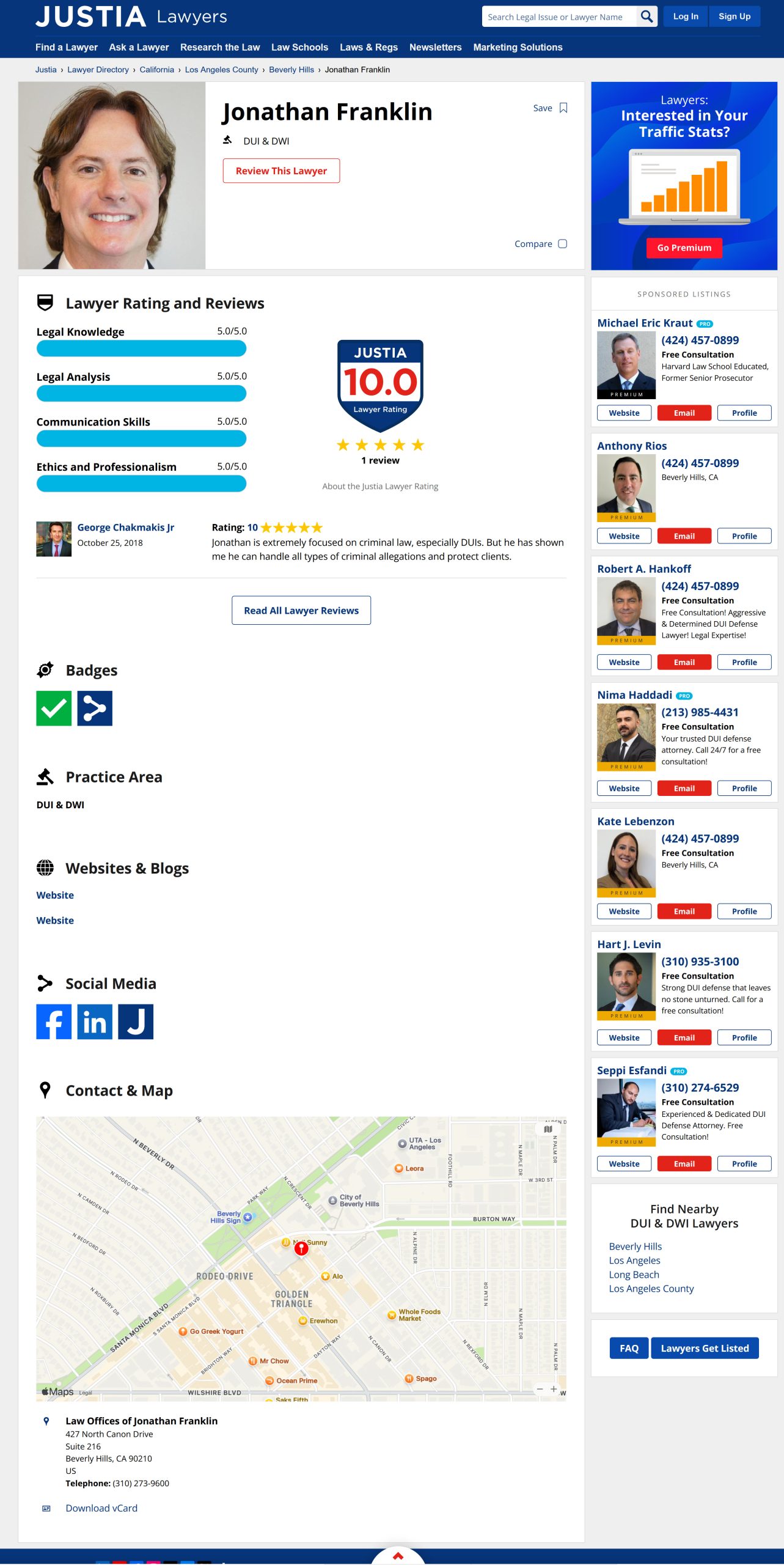
“I won’t say anything bad about a police officer.”

That was attorney Jonathan Scott Franklin’s reported response when Kevin Perelman attempted to explain that LAPD officers had fabricated or distorted the allegations underlying his 2013 criminal case.

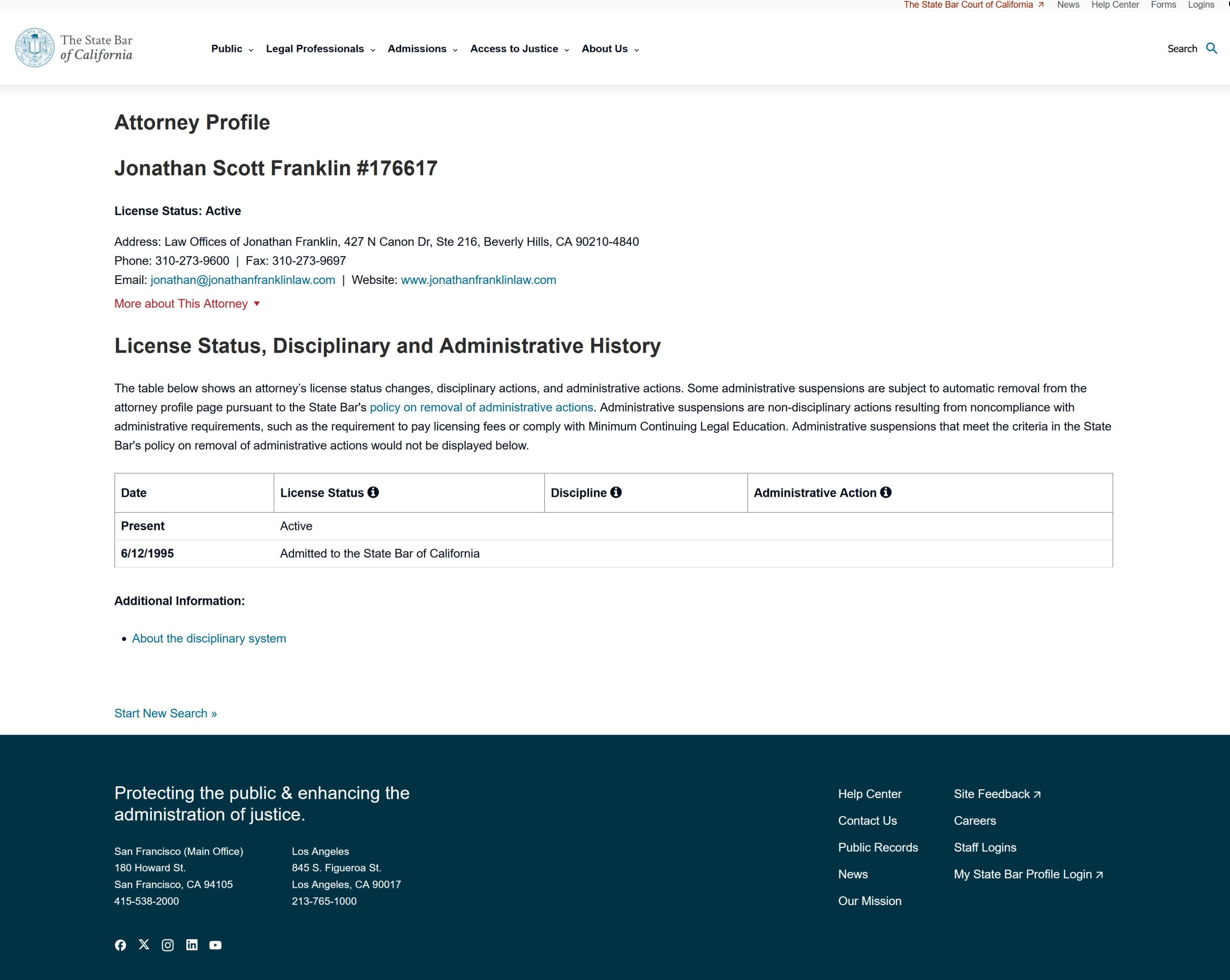
California Bar: 176617

Franklin was not retained to protect police officers from criticism. He was retained to investigate the evidence, test witness credibility, challenge false allegations, expose police misconduct, and protect his client’s constitutional rights.

Instead, the defense abandoned the central issues: whether Officer Jensen, Senior Lead Officer Charles “Sean” Dinse, restaurant personnel, and Alexandra Derse supplied false, exaggerated, or coordinated accounts; whether the incident resulted from continuing provocations and threats; and whether five criminal counts were manufactured from Perelman peacefully sitting on a public sidewalk with a small protest sign.

The case did not arise from violence, an encampment, obstruction of a crowded sidewalk, or a trespass observed by police. It arose after prolonged provocations and cryptic warnings at a restaurant and most public businesses or places her goes to based on mass defamation of character, disinformation, and using the Internet to globally and federally coordinate these methods to try to make him look unstable or like he suffers from mental illness, followed by Perelman’s peaceful public protest and request for Jensen’s badge number.

All five counts were ultimately dismissed. Before that happened, however, Perelman was placed into an inadequately disclosed plea and LAPD CAMP arrangement without informed awareness of CAMP’s identity, scope, information-gathering practices, duration, or possible future consequences. That arrangement may have generated police and mental-health records capable of being carried into later cases and used to reinforce false narratives intended to justify doing whatever was necessary to discredit, institutionalize, incarcerate, or otherwise remove him from society—continuing a pattern he reports experiencing since childhood, based on shifting labels and unsupported rationalizations that changed whenever earlier explanations failed.

Not an Isolated Restaurant Dispute

The 2013 incident was not an isolated disagreement with one restaurant.

Perelman had already observed what he describes as an extremely large network of businesses, community participants, neighborhood groups, security personnel, police-connected circles, and psychology-connected individuals exchanging information and disinformation about him with the Perelman Family and finding out around 2001 with his friend and business partner Michael Patrick Huntley, and Paul Humphrey who worked at LAPD in 1998. Such death threats from Mike Huntley were

“I have given you enough rope to hang yourself with”

“World of paranoia”

“Havea good life now”

“You had better live a careful life”

“You are too out of control for California”

Many other threats

Internet communications allowed accusations, photographs, personal information, psychiatric labels, and suggested methods of confrontation to move from one location to another. This allegedly produced recurring incidents at unrelated restaurants, coffee shops, stores, automobile events, neighborhoods, and other public locations.

Perelman would enter a business, order normally, pay, and attempt to relax. The provocations would then begin: passive-aggressive service, incorrect orders or charges, cryptic remarks, conspicuous gestures, indirect threats, staged disputes, or conduct apparently intended to obtain a reaction. These tactics that have been exponentially growing since a young age with LAPD and Community Stalking operations to remove those they simply don’t like out of HATE from society.

When one group stalking method failed, other locations allegedly introduced newer tactics. That changing pattern is important. It shows that similar conduct recurred across businesses that appeared unrelated in person but could be connected through internet communications, neighborhood-watch networks, police contacts, private social-media groups, or circulated misinformation.

The available 2013 docket does not independently prove the entire network. Establishing its participants would require social-media records, police intelligence files, emails, messages, witness testimony, dispatch records, business communications, and discovery that Franklin never meaningfully pursued.

The My Brother’s Bar-B-Q with connected business of enormous circles incident must therefore be examined as one documented episode within a much broader alleged system of surveillance, provocation, labeling, reporting, and removal—not as a self-contained restaurant disagreement.

A Pattern Observed Since Childhood

The operations described here did not begin in 2013.

Perelman reports observing changing forms of monitoring, information-sharing, psychological labeling, community participation, manufactured confrontations, and efforts to provoke him since childhood. When one justification failed, another appeared with larger and larger groups befriending or taking part if they saw Kevin. When one accusation could not be sustained, a different accusation or mental-health label replaced it.

That persistence is central to the asserted motive. If the activity continues regardless of how peacefully, responsible, or stably a person behaves, it cannot reasonably be explained as an ordinary response to particular misconduct.

In Perelman’s account, compliance did not end the activity. Good behavior did not end it. Demonstrating stability did not end it. Instead, the pressure allegedly continued through changing methods intended to discredit him, isolate him, manufacture criminal incidents, obtain psychiatric labels, force institutionalization, secure incarceration with false arrests, forged and fraudulent Police reports to remove from society at all costs out of someone’s HATE for their child with LAPD indoctrinating mass conspiring terror and stalking networks, or fulfill recurring threats that he would ultimately be “dead or gone.” While people laugh and pretend it’s a game or joke.

The 2013 prosecution must therefore be examined as an escalation within that longer alleged pattern—not as the event that created it.

Racially Charged Provocations and the Artwork Narrative

The larger history also includes reported racial slurs, threats, and deliberate efforts to use race-related accusations to provoke Perelman and distort his reactions.

Perelman reports repeatedly hearing the threatening statement, “No relaxing for you, nigger from black individuals with parts of the surrounding harassment network. In context, The statement as both a racial insult to the Jewish Community and a warning that he would not be permitted to sit peacefully in restaurants, coffee shops, or other public places. This is to manufacture the appearance of Mental Illness with the Judicial System, Psychology Community, and Police out of hate or to cover up the crimes against him when they started at a young age.

The legal importance is not the race of an individual participant by itself. A person’s racial identity does not establish conspiracy, bias, or criminal motive. The relevant evidence would be the threatening language, conduct, communications, repetition across locations, relationships among participants, and whether those participants circulated a common narrative.

Perelman identifies Alexandra Derse as Black and considers that fact relevant because of the broader pattern of racially charged provocations and reversed racial accusations surrounding him. Her racial identity alone does not prove that she acted with racial animus. It does, however, make it necessary to investigate whether her disputed absurd and infinitesimal business-card allegation was independent or connected to the recurring racialized narrative, internet communications, or other participants who had used threats and slurs.

The same network allegedly focused repeatedly on Perelman’s artwork. One work involved a photo shoot with a Black model identified as Ariana, photographed on a chessboard as part of Perelman’s visual-effects and photographic work. Perelman states that Ariana initially contacted him about participating in the photo shoot and that she was also interacting with or assisting the larger groups monitoring him.

The importance of the episode is that images from the photo shoot allegedly became part of a continuously changing justification for public hostility: private artwork was extracted from its creative context, circulated among groups, and used to encourage additional scrutiny, provocation, or defamatory claims.

Perelman’s sidewalk message—“Smeared for Creating Art,” shown in the surviving photograph with the closely related wording “Smeared for Making Art”—was a response to that claimed misuse of his artwork. Also applying to Art Therapist, Anita Perelman, since he was very young with her neurotic over analyzing of intricate aspects of his life that normal people who aren’t hypersensitive don’t look at.

He was not protesting one isolated meal. He was protesting the alleged circulation of his artwork and personal information among large groups of unheard of proportions that repeatedly supplied new changing and evolving rationalizations for harassment and removal from society out of HATE. The sign communicated that he was being publicly smeared through distorted interpretations of his creative work. This changes from Artwork to almost every other aspect of his life.

The reported racial threats, the Derse allegation, the Ariana photo-shoot history, and the continuing focus on Perelman’s artwork should not be collapsed into an accusation against an entire racial community and mass mobs from city to city, state to state. They should be investigated as particular statements, acts, communications, and relationships among identifiable people. That evidence—not race alone—could establish whether racial hostility or the manipulation of racial narratives supplied motive.

What Happened at My Brother’s Bar-B-Q

Perelman entered My Brother’s Bar-B-Q as a paying customer. He ate, paid his bill, and left.

He was not told that he was prohibited from entering. He was not served with a written trespass notice. He was not ordered to leave and then found refusing to do so. Restaurant personnel accepted his order, served him, accepted his payment, and allowed the customer transaction to be completed.

During one encounter, an employee initiated an aggressive and cryptic conversation about how people should not post negative reviews of businesses on Yelp. Perelman had not mentioned Yelp or threatened to post a review.

The importance was not simply the word “Yelp.” The employee sparked an unnecessary dialogue about customers publicly criticizing businesses while Perelman was already experiencing nonstop instigations, harassment, provocations, and indirect threats.

The statement could be examined as an attempt to obtain a reaction, an indirect warning against reporting the restaurant’s treatment of him, or evidence that personnel were discussing reputational complaints and had a motive to silence criticism.

Despite being served and allowed to pay, Perelman was later accused of trespassing.

The Public-Sidewalk Protest

After the restaurant encounters, Perelman sat on a public sidewalk with a small sign stating:

“Smeared for Creating Art.”

The surviving photograph shows the closely related wording:

“Smeared for Making Art.”

The message was a quiet protest against the continuing harassment and claimed use of Perelman’s artwork to defame, provoke, or psychologically label him.

This was not a homeless encampment. There were no tents, bedding, carts, accumulated property, or blocked pedestrian route. It was one person with a small sign. The photograph does not show a crowd being obstructed or a dangerous condition.

The sidewalk and restaurant were different locations. A person peacefully sitting on a public sidewalk is not simultaneously remaining inside a restaurant after being ordered to leave.

That contradiction is central to the trespass counts. If Jensen and Dinse encountered Perelman outside on a public sidewalk, what evidence established that he was then trespassing on restaurant property? If the restaurant previously served him, accepted payment, and never told him not to return, what notice established a knowing refusal to leave?

Franklin should have investigated those questions before discussing any plea.

Officer Jensen and the Badge-Number Request

Jensen approached Perelman on the sidewalk with Charles Sean Dinse present.

Jensen focused on removing him rather than investigating the provocations, reported threats, or reason for the protest. Jensen stated that a person could sit on the sidewalk for only approximately five minutes and directed Perelman to leave.

Perelman was prepared to leave. Before doing so, he asked Jensen for his badge number.

Jensen reportedly responded in substance, “Sure, I’ll give you my badge number,” and then issued the misdemeanor citation that became the foundation for the criminal case.

The timing matters. The citation followed Perelman’s request to identify the officer and seek accountability. The encounter did not escalate because Perelman attacked an officer, established an encampment, obstructed a crowd, or refused repeated lawful commands. It escalated after he questioned Jensen’s indifference to the continuing instigations and requested his badge number.

That sequence shows the reoccurring retaliation Jensen issued and expanded the citation because Perelman questioned police conduct and requested identifying information?

Charles Sean Dinse and Internet-Based Neighborhood Operations

Dinse’s presence is particularly important because his later public history supplies context that Franklin should have investigated.

This incident is significant because the 2013 case marks the point at which Dinse first exposed the structure of the police-connected neighborhood operations that had followed Perelman in changing forms since childhood—using coordinated provocations, circulated disinformation, unsupported mental-health labels, and even a disputed, facially absurd, and infinitesimal business-card allegation inflated into a criminal battery charge to manufacture false narratives and justify removing him from society.

Dinse was later sued personally in federal court, together with the City of Los Angeles, in Rex Schellenberg v. City of Los Angeles et al., U.S. District Court for the Central District of California, case No. 2:20-cv-01313. Schellenberg’s complaint asserted federal civil-rights claims under 42 U.S.C. § 1983 arising from alleged police harassment, dissemination of personal and purportedly false information through internet-based neighborhood groups, and resulting actions against him. The filing establishes that Dinse and the City were defendants in a federal civil-rights lawsuit; the complaint’s allegations should not be characterized as adjudicated findings unless supported by a specific subsequent court ruling.

The Schellenberg complaint alleged that Dinse participated in internet-based neighborhood groups through which residents and police exchanged photographs, locations, personal information, accusations, and statements concerning unhoused or otherwise targeted individuals.

The same groups that have been working on Kevin Perelman the majority of his life with LAPD.

Contemporary reporting stated that Dinse allegedly posted Schellenberg’s location and circulated sensitive or erroneous claims about his housing history, physical condition, mental health, and possible drug use. Schellenberg alleged that those disclosures encouraged residents to contact police, created pretexts for additional police action, contributed to continuing harassment, and culminated in the improper towing of his vehicle.

The lawsuit reportedly described Dinse’s participation in Facebook groups where information about selected individuals was distributed among police and community members. LAPD officials later acknowledged concerns about such groups, including violent comments advocating that unhoused people be poisoned or shot, and officers were reportedly instructed to stop participating in the pages.

Those allegations resemble the structure described throughout Perelman’s account:

  • separate residents and businesses connect through internet communications;
  • police officers participating in or monitoring neighborhood networks;
  • photographs and personal information circulated without meaningful verification;
  • unsupported mental-health, drug-use, dangerousness, or instability labels distributed as fact;
  • community members encouraged to watch, photograph, report, confront, or help remove selected individuals;
  • repeated police calls creating a manufactured appearance of continuing instability; and
  • police contacts later cited as confirmation of the narrative that generated those contacts.

Perelman characterizes these operations as neighborhood terror groups because their alleged effect extended beyond legitimate observation or reporting. The claimed methods involved coordinated intimidation, public labeling, privacy invasions, repeated police contacts, and community pressure intended to remove selected people.

The Schellenberg complaint does not establish that every allegation against Dinse was adjudicated as true. It does establish that Perelman was not the only person to accuse Dinse of using police-connected internet groups to circulate personal information and unsupported mental-health or drug allegations while directing community attention and continuing police action toward a particular individual.

Around 1999, gym manager Rodie Morales befriended Kevin Perelman and took him to strip clubs throughout Los Angeles. Michael Patrick Huntley had encouraged Perelman to join the gym and allegedly manipulated him into enrolling through Morales. Perelman maintains that Morales, Paul Humphry, Huntley, and others were working together to gain his trust and engineer situations that could later be used to justify his arrest. This included an incident in which Morales allegedly offered Perelman a trash bag containing what was represented to be police-supplied marijuana and attempted to persuade him to bring it into his home while taking Kevin Perelman to strip clubs all across Los Angeles working defamation of character and disinformation operations all across the United States. Perelman identifies this as part of a planned operation intended to manufacture grounds for an unlawful arrest and character assassinations.

Perelman reports that similar strip-club outings and other various setup attempts, or frame jobs with a disinformation campaign and encounters occurred during his years at Southern Oregon State College in 1991 and the University of Colorado around 1993 – 1997. Individuals connected to these events allegedly included an Alaskan exchange student, Eric Christianson, members or associates of law enforcement in Oregon and San Diego, and Russian exchange student Val Morozov. Perelman identifies the repetition of these encounters across different schools, states, Businesses, Colleges, and social groups as evidence of a broader and continuing connected pattern to remove from society rather than unrelated social events with these illegal Police operations.

That documented comparison should have caused Franklin to investigate:

  • Dinse’s participation in Facebook and neighborhood groups;
  • communications with restaurant personnel and nearby residents;
  • online posts concerning Perelman;
  • private subgroup communications;
  • photographs and personal information being distributed across enormous circles;
  • racial, mental-health, or dangerousness labels;
  • whether complaints were independently created or coordinated;
  • whether police directed residents to generate repeated calls;
  • whether businesses were encouraged to confront or exclude Perelman; and
  • whether the five counts were connected to a broader police-and-community operation.

Franklin apparently investigated none of it.

The Five Counts

Los Angeles Superior Court case No. 3PY03498 contained five counts.

Count 1 — Los Angeles Municipal Code § 41.18(d)

This was a sidewalk-related charge.

Perelman was sitting with a small protest sign on a quiet public sidewalk. The photograph does not show an encampment or blocked pedestrian route. The available record does not identify anyone prevented from passing.

The sign communicated a protest message. Using a sidewalk ordinance selectively to suppress that message or retaliate against Perelman for criticizing a business or police officer, especially within self-defense to try to dissolve huge, coordinated stalking groups would raise First Amendment concerns.

Count 1 was connected to the later no-contest plea and conditional resolution. It was dismissed on September 26, 2014, in furtherance of justice under Penal Code § 1385.

Count 2 — Los Angeles Municipal Code § 41.18(a)

This was a second sidewalk-related count arising from the same basic encounter.

Rather than documenting distinct dangerous conduct, the two municipal counts multiplied one peaceful incident into separate criminal accusations.

Count 2 was dismissed on September 26, 2013, under Penal Code § 1385.

Count 3 — Penal Code § 602(k): Trespass

This count alleged refusal to leave property after being requested to leave.

That event did not occur as charged. Perelman was outside on the public sidewalk when Jensen and Dinse contacted him. During his earlier restaurant visit, he entered as a customer, ate, paid, and left. He was never told he was forbidden from entering.

A trespass conviction would have required evidence of proper notice, Perelman’s actual location, a request to leave, his knowledge of that request, and a willful refusal. Those facts were not established at trial because no trial occurred.

Count 3 was dismissed on September 26, 2013, under Penal Code § 1385.

More troubling is the recurring pattern Perelman reports across businesses throughout the United States: employees initially welcome him inside and allow him to make a purchase, but then allegedly begin a sustained sequence of instigations, provocations, and confrontational interactions intended to produce a reaction before contacting the police. Perelman identifies the repetition of this sequence across numerous unrelated locations from the majority of places he goes to, as evidence of a coordinated pattern and motive, rather than isolated customer disputes. He connects these practices to police-connected operations involving LAPD Officer Charles Sean Dinse and earlier individuals associated with law enforcement, including Paul Humphry beginning around 1998 and Michael Patrick Huntley, whom Perelman had known since approximately age fourteen. Perelman maintains that these recurring tactics have been used in changing forms since childhood to generate adverse reports, manufacture the appearance of instability or criminal conduct, and ultimately remove him from public life and society.

Count 4 — Penal Code § 242: Battery

This count reportedly arose from Black employee Alexandra Derse’s accusation that Perelman threw a business card or piece of paper at someone.

Perelman states that the event did not occur. Even apart from that factual dispute, the account transformed an alleged business card into an absurd assault narrative without meaningful evidence of injury, danger, force, or harmful contact.

A paper object can theoretically support a battery allegation if intentionally used to make harmful or offensive contact. The prosecution must still prove that the event happened, that contact was intentional, and that the complaining witness’s account was reliable.

No jury tested Derse’s allegation. Franklin should have obtained surveillance footage, interviewed witnesses, examined inconsistencies, and investigated Derse’s communications with restaurant employees, Jensen, Dinse, internet groups, and other participants.

Ariana, a black girl, initially contacted Perelman through MySpace.com and asked him to photograph her. Perelman agreed, and the resulting creative work included a staged photograph of Ariana in the photoshoot she wanted to do, who is Black, posed on a chessboard. Perelman reports that harassment, threats, and coordinated group activity directed at him intensified after the photo shoot, as well as her showing hostility towards Kevin afterwards on Myspace.com and that images from the session were subsequently circulated, reinterpreted, and used to construct hostile narratives about him. While adding them to the changing accusations and narratives to these mass groups since early childhood. Because Derse’s allegations arose within this broader context, including Kevin’s reported racial threats with conspiring businesses, reversed accusations of racism, and the manipulation of the context of Perelman’s artwork, the defense should have investigated whether communications concerning Ariana or the circulated photographs supplied a motive for false or exaggerated accusations. Derse’s race alone would not establish racial hostility or motive; that would need to be demonstrated through specific statements, communications, conduct, timing, and connections among the participants. Especially with nonstop 49 year rotating coordinated conspiring groups that has never stopped.

Count 4 was dismissed on September 26, 2013, under Penal Code § 1385.

Count 5 — Penal Code § 602(k): Second Trespass

The filing contained a second charge under the same trespass statute.

Two trespass counts required two legally and factually distinct violations. Each count required its own date, notice, request to leave, willful refusal, and supporting evidence. An officer could not convert an unsupported statement that someone appeared at a restaurant more than once into multiple criminal trespasses. Especially if they welcome the victim in, and fabricate lies with LAPD, which is a common nonstop pattern of behavior with LAPD, and these Public Businesses before Kevin Perelman even walks in the door for the first time. Showing that the anonymous employees know who Kevin Perelman before he enters almost any location, in which Charles Sean Dinse, and others at LAPD deny is happening and state is supposedly mental illness. Stating HATE INFORMATION across the Internet is not possible, while Charles Sean Dinse posts disinformation about Kevin Perelman on his facebook account and other Internet Blogs Forums.  The very crime Charles Sean Dinse was sued for.

Perelman ate, paid, and left. He was never told not to return. When contacted by police, he was outside on a public sidewalk.

Count 5 was dismissed on September 26, 2014, under Penal Code § 1385.

All Five Counts Were Dismissed

The court record shows:

  • Count 1 — dismissed September 26, 2014;
  • Count 2 — dismissed September 26, 2013;
  • Count 3 — dismissed September 26, 2013;
  • Count 4 — dismissed September 26, 2013; and
  • Count 5 — dismissed September 26, 2014.

As of 2026, none of the five counts remains an active conviction.

That does not automatically erase every historical police report, plea entry, CAMP record, or database notation created during the case. Which seems to be the their real MOTIVE. It does mean that the final disposition of every count is dismissal.

Any later officer, prosecutor, probation official, attorney, judge, or evaluator relying on this matter must disclose that all five charges were dismissed.

Franklin’s Refusal to Challenge Police

Franklin’s reported statement—“I won’t say anything bad about a police officer”—was incompatible with the defense the case required.

The disputed issues concerned police and witness conduct:

  • whether Jensen retaliated after the badge-number request;
  • whether Jensen and Dinse accurately described the sidewalk;
  • whether anyone was obstructed;
  • whether Perelman was ever ordered to leave restaurant property;
  • whether two distinct trespasses occurred;
  • whether Derse’s business-card accusation was true;
  • whether charges were expanded after Perelman protested;
  • whether Dinse communicated with neighborhood or business groups;
  • whether police circulated mental-health or dangerousness labels;
  • whether racial narratives or artwork were being distributed;
  • whether the citation suppressed protected expression; and
  • whether five counts were used to manufacture an appearance of instability.

Franklin allegedly failed to:

  • obtain complete police and investigative reports;
  • demand dispatch and call records;
  • obtain restaurant surveillance;
  • interview material witnesses;
  • investigate Derse’s motive and communications;
  • inspect the locations of the sidewalk and restaurant;
  • document the absence of an obstruction;
  • investigate Jensen’s and Dinse’s histories;
  • investigate Dinse’s community-group activity;
  • identify the origin of the racial and mental-health narratives which actually link to 1980 and Kevin Perelman kissing a black girl at sunny skies day camp, and the Perelman families hostility over the harmless event using their psychology degrees with their police and judicial friends with Paul Humphrey as weapons to lash out in anger and rage over a normal situation of warmth.;
  • challenge the multiplication of one event into five counts;
  • explain CAMP adequately;
  • preserve the complete plea terms; and
  • ensure that the court accurately understood Perelman’s civil-rights concerns.

Instead, Franklin moved the case toward a plea while insulating the police narrative from meaningful scrutiny.

CAMP Was Not Properly Explained

The transcript indicates that the resolution involved CAMP—the LAPD Case Assessment and Management Program.

CAMP operates within LAPD’s Mental Evaluation Unit. LAPD materials describe it as a program pairing detectives with mental-health professionals to identify, monitor, engage, and manage people believed to have recurring contacts involving possible mental-health concerns.

CAMP may collect or use:

  • police reports;
  • Mental Evaluation Incident Reports;
  • calls for service;
  • officer observations;
  • statements from family members;
  • information from neighbors and community members;
  • available hospital or treatment information;
  • prior police contacts;
  • investigative reports;
  • referrals from officers or clinicians; and
  • information from later encounters.

A later LAPD outline stated that CAMP “cases never close.” That description raises an important question: did the 2013 agreement create an open-ended police and mental-health intelligence file that continued after all five charges were dismissed?

The ordinary Tahl waiver did not clearly explain:

  • what CAMP meant;
  • what information could be collected;
  • who could provide information;
  • whether neighbors or businesses could be contacted;
  • whether family members could be interviewed;
  • whether records could be retained indefinitely;
  • whether participation was voluntary;
  • whether consent could be withdrawn;
  • whether CAMP continued after dismissal;
  • whether information could be disclosed to other agencies; or
  • whether future police contacts would be added.

The transcript refers to a “second sheet,” but that sheet is missing from the available records.

If that sheet contained the CAMP terms, its absence is material. A person cannot knowingly accept an arrangement whose central conditions were not explained or provided to him.

Judge Shellie Samuels and the “Rest of Your Life” Exchange

The March 26, 2014 transcript contains this exchange:

THE COURT: Can you do it for 12 months?

THE DEFENDANT: [Nods.]

THE COURT: Can you then do it for the rest of your life?

THE DEFENDANT: Do I have civil rights to make that decision?

THE COURT: No, you don’t have civil rights to break the law.

THE DEFENDANT: For the year.

Perelman’s reference to civil rights was not an admission that he intended to commit crimes. It reflected concern that compliance could not require surrendering constitutional rights or silently accepting unlawful police activity.

Samuels immediately reframed that concern as though Perelman claimed a “civil right to break the law.” That was not what he said.

The phrase “for the rest of your life” is unexplained. It could have concerned obeying laws generally, continuing treatment, cooperating with CAMP, avoiding locations, or maintaining an undefined behavioral condition. Without the preceding discussion and missing second sheet, its meaning cannot safely be assumed.

If Samuels was referring to CAMP or continuing mental-health monitoring, a lifetime arrangement could not properly be imposed through an ambiguous exchange without explaining the monitoring, information collection, disclosure, and duration.

The fragment does not prove that Samuels ordered lifetime CAMP participation. It demonstrates why the complete transcript and missing paperwork are indispensable.

Promised LAPD Assistance That Disappeared

The arrangement was presented as though LAPD would work with Perelman regarding the conduct he had been reporting.

That assistance lasted approximately one telephone call—or, at most, a very small number of dismissive contacts. LAPD did not meaningfully investigate the businesses, neighborhood groups, racial threats, online communications, provocations, artwork-related defamation, or police-connected activity.

No safety plan emerged. No investigation was disclosed. No officer appears to have determined whether community participants were provoking encounters or supplying false reports.

The promised assistance operated as an inducement: accept the arrangement and LAPD will finally examine what is happening.

Once the plea was obtained, the cooperation disappeared.

If police assistance was material to Perelman’s decision, Franklin had a duty to make the promise written, specific, enforceable, and part of the official record.

The Risk of a Self-Reinforcing CAMP File

CAMP creates a particular danger when its original police narrative is disputed.

An officer or neighbor labels someone unstable. CAMP records the allegation. Later officers see a mental-health history and interpret ordinary frustration through that lens. Their observations are added to the file. Community members learn police consider the person a concern and submit additional reports. The growing number of contacts is then cited as proof that the original label was correct.

The allegation becomes the premise, the premise becomes the psychiatric label, and the label becomes the asserted justification for additional monitoring, disbelief, exclusion, treatment, medication, institutionalization, or punishment.

Every entry therefore requires examination:

  • Who supplied the information?
  • Was it firsthand?
  • Was it corroborated?
  • Did it originate with Dinse, Jensen, Derse, restaurant personnel, family members, or neighborhood groups?
  • Were racial threats and provocations omitted while reactions were recorded?
  • Was disputed information marked as disputed?
  • Were dismissed charges still described as criminal conduct?
  • Did CAMP retain information after dismissal?
  • Was information distributed to later officers, prosecutors, probation officials, or evaluators?

Without the CAMP file, those questions remain unanswered.

Potential Professional Misconduct

Franklin’s actions require examination under duties of competence, loyalty, communication, investigation, and informed consent.

Potential issues include:

  • failure to communicate material plea terms;
  • failure to explain CAMP;
  • failure to obtain informed consent;
  • failure to preserve the complete agreement;
  • failure to investigate exculpatory evidence;
  • failure to challenge materially false police accounts;
  • failure to impeach adverse witnesses;
  • failure to investigate coordinated internet communications;
  • failure to investigate racial threats and manipulated artwork;
  • failure to identify conflicts of interest;
  • failure to correct the court’s mischaracterization of Perelman’s statement;
  • inducing a plea without enforceable police assistance; and
  • placing institutional loyalty to police above the client’s defense.

Depending on the evidence, these matters could implicate California Business and Professions Code §§ 6068 and 6106, Rules of Professional Conduct 1.1, 1.2, 1.4, and 1.7, ineffective-assistance principles, and the requirement that a plea be knowing, intelligent, and voluntary under Boykin-Tahl.

Records Required for Reconstruction

A complete investigation requires:

  1. Every 2013 and 2014 transcript.
  2. The complete context of the “rest of your life” exchange.
  3. The missing second sheet.
  4. Every CAMP referral, assessment, case-management record, and status entry.
  5. Mental Evaluation Incident Reports.
  6. MEU investigative reports.
  7. The prosecution’s complete file.
  8. LAPD dispatch audio and calls for service.
  9. Jensen’s and Dinse’s notes and reports.
  10. Body-camera, dash-camera, or station recordings.
  11. Restaurant surveillance.
  12. Derse’s original statements.
  13. Communications among Derse, restaurant personnel, Jensen, and Dinse.
  14. Dinse’s neighborhood-group and Facebook communications.
  15. Posts or messages concerning Perelman’s artwork.
  16. Communications involving the Ariana photo shoot.
  17. Records documenting the reported racial threats.
  18. Police intelligence or officer-safety bulletins.
  19. Documents showing whether CAMP continued after September 2014.
  20. Franklin’s complete client file and investigative records.

Why the Dismissed Case Still Matters

The charges were dismissed, but the institutional narrative not only survived but is being used as a weapon to illegal defame all across the United States, and World to rile the masses against Kevin Perelman. As they have been doing since he was a young child. While telling Kevin Perelman, no one knows of him and he’s imagining it.

This reinforces Michael Patrick Huntley’s death threats in 2001 “World of Paranoia”.

Disseminating nonstop worldwide disinformation and defamation of character while refusal to acknowledge the situation by design to use information to Insite worldwide riots to make people look unstable to remove from society. As they create newer and newer narratives until the target, and victim is no more.

Police reports, CAMP entries, witness allegations, court comments, racialized narratives, and undisclosed mental-health labels can influence later officers, prosecutors, probation departments, judges, and experts even when the charges that created them no longer exist.

The danger is circular:

  1. Community members provoke or report the selected person.
  2. Police omit the provocations and document the reaction.
  3. Police and Judicial Employees lie stating nothing is going on with refusal to investigate what they already know is going on.
  4. CAMP retains the resulting allegation.
  5. Later officers encounter the historical label.
  6. New contacts are interpreted through that label.
  7. Later prosecutors and judges cite the accumulated contacts.
  8. The record becomes “proof” of the accusation that generated it.

The number of reports does not prove their truth when they may share a common source, online network, police contact, or coordinated narrative.

Conclusion

The 2013 case was not five proven criminal acts. It was one sidewalk encounter expanded into five counts:

  • two overlapping sidewalk charges;
  • two unsupported trespass charges; and
  • one disputed business-card battery allegation.

Perelman entered the restaurant as a customer, ate, paid, and left. He was not told that he was prohibited from entering. When Jensen and Dinse contacted him, he was outside on a public sidewalk with a small sign stating “Smeared for Creating Art” or “Smeared for Making Art.” He was not operating an encampment or blocking pedestrians.

He was as nice as can be and accepting to the employee’s met with hostility anger, and rage just like he always is.

The protest arose from a much broader alleged history of provocations, internet-based disinformation, racial threats, manipulated artwork, and recurring conduct across numerous businesses and public locations. That history included the reported “No relaxing for you, nigger” death threat and the circulation or distortion of artwork such as the Ariana chessboard photo shoot.

No individual’s race proves motive. Motive must be established through statements, actions, communications, repetition, and relationships. Franklin’s duty was to investigate that evidence rather than refuse to challenge police.

The encounter escalated after Perelman asked Jensen for his badge number and questioned the officer’s indifference to the reported instigations. This also shows Dinse, and Jenson had motive since day one. And since 2009 when Topanga division community policing police station was built.

Franklin’s statement—“I won’t say anything bad about a police officer”—protected Jensen’s and Dinse’s accounts from scrutiny, left Derse’s allegation untested, ignored the larger network, and moved Perelman into an inadequately disclosed CAMP arrangement.

The later federal civil-rights lawsuit by Rex Schellenberg supplied a documented parallel: another person accused Dinse of using internet-connected neighborhood groups to distribute personal information and unsupported mental-health or drug allegations, direct community attention toward a selected individual, and generate continuing police action.

All five counts were ultimately dismissed. What remains unresolved is what reports, labels, CAMP entries, and police intelligence survived; who continued using them; and whether the 2013 case became a foundation for later attempts to portray Perelman as mentally unstable rather than investigate the conduct he reported.

The case matters not because of its comparatively minor charges—all of which were ultimately dismissed—but because it provides an early documented view of the alleged method: repeated provocation, stacked accusations, police intervention, undisclosed mental-health case management, and the conversion of reported civil-rights concerns into suggestions of criminality or instability. Perelman maintains that the 2013 proceeding reinforces a broader pattern dating to approximately 1977—a pattern that has continued for forty-nine years, expanded exponentially through police-connected and community networks, and grown progressively more intrusive, aggressive, and dangerous.

Provoke the person. Conceal the provocation. Manufacture or exaggerate the reaction. Multiply the accusations. Refuse to investigate the underlying misconduct. Attach a psychiatric narrative as cover ups. Preserve the resulting institutional record for future use.

That is the pattern requiring disclosure, independent investigation, and judicial review.

LEGAL ADDENDUM

Potentially Implicated Constitutional Provisions, Statutes, and Professional Duties

This appendix is an issue-spotting reference, not a finding that any person committed a crime or is civilly liable. Each provision has distinct elements, defenses, immunities, limitation periods, and proof requirements. Criminal statutes generally do not create a private right to prosecute; charging decisions belong to authorized prosecutors. The provisions below become relevant only if admissible evidence establishes the required conduct, intent, causation, state action, injury, or agreement.

A. Statutes and Ordinances Appearing in the 2013 Case Record

  • Los Angeles Municipal Code §41.18(d) — the count to which a temporary no-contest plea was entered on September 26, 2013. The plea and resulting finding were withdrawn and vacated on September 26, 2014, and the count was dismissed under Penal Code §1385.
  • Los Angeles Municipal Code §41.18(a) — count 2; dismissed under Penal Code §1385 on September 26, 2013.
  • California Penal Code §602(k) — trespass by entering land to interfere with or injure a lawful business or occupation; charged as counts 3 and 5. Count 3 was dismissed September 26, 2013, and count 5 was dismissed September 26, 2014.
  • California Penal Code §242 — simple battery; charged as count 4 and dismissed September 26, 2013.
  • California Penal Code §977 — permitted counsel to appear for Perelman in his absence at the August 19, 2013 misdemeanor proceeding, when counts 3 through 5 were added.
  • California Penal Code §1385 — dismissal in furtherance of justice. Every count was ultimately dismissed under this section.

B. Federal Constitutional Rights Potentially Implicated

  • First Amendment — speech, peaceful protest, petitioning government, requesting police assistance, criticizing public officials, and protection against governmental retaliation for protected expression.
  • Fourth Amendment — protection against unreasonable searches, seizures, arrests, prolonged detention, and certain forms of government-directed surveillance.
  • Fifth Amendment — privilege against compelled self-incrimination and federal due process. In state proceedings, the Fourteenth Amendment incorporates applicable protections.
  • Sixth Amendment — effective assistance of counsel, confrontation and cross-examination, compulsory process, notice of accusations, and a fair criminal proceeding.
  • Fourteenth Amendment — procedural and substantive due process, equal protection, and incorporation of fundamental protections against state and local officials.
  • California Constitution, article I, §§1, 2, 7, 13 and 15 — state protections for privacy; speech; due process and equal protection; freedom from unreasonable searches and seizures; and rights of criminal defendants.

C. Federal Civil-Rights Statutes

  • 42 U.S.C. §1983 — civil remedy against a person acting under color of state law who causes the deprivation of a federal right. Municipal liability requires proof of an official policy, custom, practice, deliberately indifferent failure to train or supervise, or action by a final policymaker; respondeat superior alone is insufficient.
  • 42 U.S.C. §1985(3) — conspiracy to deprive equal protection or equal privileges, generally requiring a qualifying class-based discriminatory animus and an overt act causing injury.
  • 42 U.S.C. §1986 — potential liability for a person who knew of a qualifying §1985 conspiracy, had power to prevent or aid in preventing it, and neglected or refused to do so. It depends on a valid §1985 claim and has its own short limitation period.
  • 42 U.S.C. §1988 — governs aspects of civil-rights remedies, including potential attorney-fee awards in qualifying federal civil-rights litigation.

D. Federal Criminal Statutes That May Require Government Investigation

  • 18 U.S.C. §241 — conspiracy to injure, oppress, threaten, or intimidate a person in the free exercise or enjoyment of federal rights.
  • 18 U.S.C. §242 — willful deprivation of federal rights under color of law.
  • 18 U.S.C. §1512(b) and (c) — witness tampering and corrupt obstruction involving testimony, evidence, or an official proceeding, if the federal jurisdictional and intent requirements are met.
  • 18 U.S.C. §1519 — knowingly altering, destroying, concealing, or falsifying a record with intent to impede or influence a matter within federal jurisdiction or in relation to such a matter.
  • 18 U.S.C. §2261A — certain interstate or electronic stalking conduct undertaken with the statutorily required intent and causing the specified fear or substantial emotional distress.
  • 18 U.S.C. §§2511 and 2520 — unlawful interception, use, or disclosure of wire, oral, or electronic communications, together with a potential civil remedy, subject to consent, law-enforcement, provider, and other statutory exceptions.
  • 18 U.S.C. §§2701 and 2707 — unauthorized access to stored electronic communications and a potential civil remedy, subject to statutory authorization and provider exceptions.

The federal criminal provisions above ordinarily do not authorize a private criminal prosecution. Their inclusion identifies possible referral issues, not established offenses.

E. California Criminal Statutes Potentially Implicated by Proven Fabrication, Concealment, Retaliation, or Coordinated Misconduct

  • Penal Code §118 — perjury in a legally qualifying sworn statement, requiring willful material falsity and the other statutory elements.
  • Penal Code §132 — offering as genuine a fraudulently altered or forged document or other evidence in a proceeding or authorized inquiry.
  • Penal Code §134 — preparing false or antedated evidence with fraudulent intent to produce it as genuine in a proceeding or authorized inquiry.
  • Penal Code §135 — willful destruction or concealment of evidence when a person knows it is about to be produced in an authorized proceeding or inquiry.
  • Penal Code §141 — knowingly planting, tampering with, or fraudulently altering physical evidence to cause another person to be charged or to affect a legal proceeding; enhanced consequences can apply to peace officers.
  • Penal Code §148.5 — knowingly making a false report that a felony or misdemeanor was committed to a peace officer or other listed recipient.
  • Penal Code §182 — criminal conspiracy, requiring an agreement to commit a qualifying offense and, for most subdivisions, an overt act in furtherance of the agreement.
  • Penal Code §236 — false imprisonment, potentially relevant to an unlawful detention or restraint proved to lack lawful authority.
  • Penal Code §422 — criminal threats, requiring proof of the statute’s specific language, intent, unequivocality, immediacy, gravity, and sustained-fear elements.
  • Penal Code §422.6 — willful interference with another person’s civil rights by force or threat of force because of an actual or perceived protected characteristic.
  • Penal Code §646.9 — stalking, requiring repeated following or harassment plus a credible threat and the required intent.
  • Penal Code §136.1 — preventing or dissuading a victim or witness from reporting, assisting, testifying, or attending proceedings, including specified attempts to do so.
  • Government Code §6200 — theft, removal, destruction, mutilation, alteration, or falsification of public records by an officer having custody of them, subject to the statute’s precise requirements.
  • Penal Code §§630–638.55, including §§631, 632 and 637.2 — California’s Invasion of Privacy Act, governing interception and recording of communications and providing a civil remedy in qualifying cases, subject to consent and statutory exceptions.

F. California Civil Statutes and Causes of Action Potentially Implicated

  • Civil Code §51.7 (Ralph Civil Rights Act) — freedom from violence or intimidation by threat of violence because of specified protected characteristics, including race, religion, ancestry, disability, and other listed classifications.
  • Civil Code §52.1 (Bane Civil Rights Act) — civil relief for interference, or attempted interference, by threat, intimidation, or coercion with rights secured by federal or California law. The required coercion and specific intent depend on the claim and governing case law.
  • Civil Code §1708.7 — civil stalking cause of action when its detailed course-of-conduct, threat, fear, and intent requirements are satisfied.
  • Civil Code §§44–46 — statutory framework for defamation, including libel and slander, subject to falsity, publication, fault, privilege, damages, and limitation defenses.
  • Civil Code §52.3 — equitable and declaratory relief concerning a governmental authority’s pattern or practice of conduct by law-enforcement officers that deprives rights, within the statute’s authorized enforcement structure.
  • Common-law false arrest and false imprisonment — potentially applicable to an unlawful arrest or detention, subject to probable cause, privilege, immunity, claim-presentation rules, and limitation periods.
  • Common-law malicious prosecution — generally requires favorable termination, lack of probable cause, malice, and resulting damage; prosecutorial, judicial, and other immunities may limit defendants or theories.
  • Negligence and intentional infliction of emotional distress — possible state-law theories only when all elements, duties, causation, damages, immunities, and Government Claims Act requirements are met.

G. Police Records, Complaints, and Disclosure Duties

  • Penal Code §832.5 — requires agencies employing peace officers to establish procedures for investigating public complaints and to make written complaint procedures available.
  • Penal Code §§832.7 and 832.8 — govern confidentiality and disclosure of peace-officer personnel records, including statutorily public categories of specified misconduct records.
  • Evidence Code §§1043–1047 — procedures and protections governing Pitchess discovery of peace-officer personnel records.
  • California Public Records Act, Government Code §§7920.000 et seq. — establishes public access to state and local records, subject to exemptions, privileges, confidentiality rules, retention realities, and judicial remedies.
  • Brady v. Maryland, Giglio v. United States, and California Penal Code §1054.1 — require disclosure of qualifying exculpatory and impeachment information in criminal proceedings. The precise duty depends on possession, materiality, timing, and the prosecution team’s access or constructive knowledge.

H. Duties Potentially Applicable to Defense Counsel and Prosecutors

For conduct occurring in 2013–2014, the professional rules then in effect must be used. Current rules may describe continuing or later duties but should not be applied retroactively without legal analysis.

  • Business and Professions Code §6068(a), (c), (d), (m) and (o) — duties to support the law; counsel or maintain only legal or just proceedings; employ truthful means; keep clients reasonably informed; and report specified disciplinary events.
  • Business and Professions Code §6106 — discipline for acts involving moral turpitude, dishonesty, or corruption, whether committed in the course of the attorney-client relationship or otherwise.
  • Former California Rule of Professional Conduct 3-110 — duty not to intentionally, recklessly, or repeatedly fail to perform legal services with competence; applicable to the 2013–2014 period.
  • Former Rule 3-500 — duty to keep a client reasonably informed of significant developments; applicable to the 2013–2014 period.
  • Former Rule 5-200 — duties of an attorney presenting a matter to a tribunal, including truthful presentation and not misleading the court by artifice or false statement; applicable to the 2013–2014 period.
  • Former Rule 5-220 — prohibition against suppressing evidence that the lawyer or client had a legal obligation to reveal or produce; applicable to the 2013–2014 period.
  • Current Rules 1.1, 1.3 and 1.4 — competence, diligence, and communication.
  • Current Rule 1.7 — conflicts of interest involving significant risk that representation will be materially limited by the lawyer’s interests or duties to others, subject to informed written consent where permitted.
  • Current Rules 3.3 and 3.4 — candor toward the tribunal and fairness to opposing parties and counsel.
  • Current Rule 3.8 — prosecutors’ special responsibilities, including disclosure obligations and duties concerning evidence that may negate guilt or mitigate an offense or sentence.
  • Current Rule 8.4 — professional misconduct involving dishonesty, fraud, deceit, reckless or intentional misrepresentation, prejudice to the administration of justice, or knowingly assisting improper judicial conduct.

A professional-rule violation is primarily a disciplinary issue and does not automatically create a civil cause of action or prove ineffective assistance. A Sixth Amendment ineffective-assistance claim is governed by Strickland v. Washington and requires both constitutionally deficient performance and resulting prejudice, subject to doctrine specific to pleas and later proceedings.

I. Judicial Conduct and Due Process

  • California Code of Judicial Ethics, Canons 1, 2 and 3 — judicial integrity and independence; avoidance of impropriety and its appearance; impartial, competent, diligent, patient, dignified, and fair performance of judicial duties; and the obligation to give parties the right to be heard according to law.
  • Federal and state due-process principles concerning judicial bias — require a neutral decision-maker. Adverse rulings or sharp remarks alone ordinarily do not establish unconstitutional bias; the full context, source of alleged bias, and objective risk of actual bias matter.
  • California Code of Civil Procedure §170.1 — identifies circumstances requiring disqualification of a California judge, including specified interests, relationships, knowledge, and situations in which a reasonable person aware of the facts might doubt impartiality.

J. Proof and Preservation Questions for Counsel

Before alleging any particular violation, counsel should identify:

  • The exact actor, date, statement, act, and legal duty.
  • Whether the actor was a government official, private person, attorney, witness, contractor, or alleged joint participant.
  • The original recording, report, metadata, dispatch record, court filing, transcript, or authenticated communication proving the act.
  • The required mental state: knowledge, willfulness, malice, fraudulent intent, discriminatory animus, specific intent, or deliberate indifference.
  • The injury and causal connection to the actor’s conduct.
  • Any warrant, consent, privilege, immunity, statutory authorization, or good-faith defense.
  • Applicable administrative exhaustion, Government Claims Act presentation, preservation, and statute-of-limitations requirements.
  • Whether a criminal statute supplies only a referral basis or also permits a private civil remedy.

This appendix should therefore be used as a structured checklist for investigation, record requests, attorney review, and amendment after evidence is authenticated—not as a substitute for matching proven facts to every statutory element.

www.KevinPerelmanTarget.com

www.TheHateCage.com

.


21150 Ventura Blvd, Woodland Hills, CA, 91364, US